Delilah Beasley was the first African American woman to be published regularly as a columnist for the Oakland Tribune in California.
She is most known for her book “The Negro Trail-Blazers of California,” published in 1919 and reprinted in 1968.
Early Life
Delilah Leontium Beasley was born in Cincinnati, Ohio, on September 9, 1871, just after the Civil War, to Daniel Beasley, an engineer, and Margaret Harris.
Beasley began her newspaper career in 1887, writing about church and social activities for the black newspaper, the Cleveland Gazette.
After her parents’ death, she went to Chicago and took a position to learn massage: she desired to become a nurse, which she became a few years later.
She traveled to California to nurse a former patient and stayed.
After moving to Oakland in 1910 at the age of 39, she wrote for the Oakland Sunshine and the Western Outlook.
In 1910, 3,055 African Americans lived in Oakland.
Trail-Blazers
To help her race; to open doors into the arts and sciences for the negro boys and girls, has been the impelling force for Delilah Beasley”
Los Angeles Times Jul 13, 1919
Oakland Tribune April 16, 1915
Beasley spent the first nine years in Oakland researching Black Americans’ history in the west at the University of California at Berkeley. She also would give presentations at local churches.
An early cover of the book
In 1919 she self-published a book called The Negro Trail Blazers of California. The book chronicled African American “firsts” and notable achievements in early California. The book includes diaries, biographical sketches, poetry, photographs, old papers, conversations with old pioneers, and a comprehensive history of early legislation and court cases.
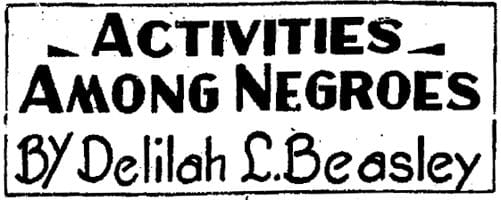
Her book paved the way for Beasley to become the first African American woman in California to write regularly for a major metropolitan newspaper. She worked for the Oakland Tribune from 1923 to 1934 and wrote a weekly column entitled “Activities Among Negroes.” The column carriedcivic and religious news of the black community
Beasley was determined to advance the rights of African Americans and women; she joined many civic clubs, including the NAACP, the Alameda County League of Women Voters, the National Association of Colored Women, the Oakland Council of Church Women, and the Linden Center Young Women’s Christian Association.
She was an honorary League of Nations Association of Northern California member.
Oakland Tribune March 3, 1928
Delilah died at the age of August 18, 1934. Beasley is buried in St. Mary’s Cemetery.
Oakland Tribune August 19, 1934
She lived for many years at 705- 34th Street.
The exterior of Delilah Beasley’s house, 705 34th Oakland, California – African American Museum & Library at Oakland
This is one of those posts where I had no writing intention, let alone know it existed. Two examples are my most popular post, “The Forgotten Tunnel,” or “The Backyard Fence War” I stumbled across articles on both while researching another post. Sometimes they pan out, and I find many exciting things to share. I wasn’t so lucky with this post, and it ended up being kind of a dud. I thought I would share it anyway.
Groundbreaking
A groundbreaking celebration was held in November of 1956 for the new Bancroft Avenue Parkway, and construction began soon after.
Oakland Tribune November 25, 1956
Bancroft Avenue was to become a major thoroughfare linking San Leandro and Oakland, relieving the traffic on MacArthur, Foothill, and East 14th (now International)
Oakland Mayor Clifford E. Rishell and Alameda County Supervisor operating an enormous earthmover, lifting the first load of earth.
Construction for the Bancroft Avenue Parkway near 98th Avenue in the city’s Elmhurst district. DATE: 1956 Photographic print Albert “Kayo” Harris & Associates, photographers. The Oakland Public Library, Oakland History Room.
They symbolized joint city-county participation.
Oakland Tribune November 25, 1956
The project’s estimated cost was $4,000,000 and was financed jointly from Oakland and Alameda County’s state gas tax funds.
Needed Relief
California Highways and Public Works Oakland Progress Page 37 – March- April 1958
The need for this arterial was foreseen as early as 1927 when the major street plan of the city was formulated. Uncontrolled subdivisions in East Oakland’s early history had left a large area with no provision for the essential east-west movement.
California Highways and Public Works Oakland Progress Page 37 – March- April 1958
The parkway was to provide the much-needed relief of Foothill Boulevard, MacArthur Boulevard, and East 14th Street (now international), as well as a direct connection to an existing major city street, Bancroft Avenue in San Leandro.
Studies for this thoroughfare were commenced in 1941, and protection of the right-of-way started.
The Bancroft Parkway
The parkway was to extend from the San Leandro city limits to East 14th Street(now International) and 46th Avenue.
“The project will convert Bancroft from a rundown noncontinuous street and railroad right-of-way to a major intercity thoroughfare and railroad parkway.”
California Highways and Public Works Oakland Progress Page 37 – March- April 1958
Corner of Bancroft and 96th Avenues in the Elmhurst district of Oakland, California. 1965 Photographer unidentified. Oakland Public Library, Oakland History Room.
The Design
The parkway had a two-lane section on each side with room for parking. In the center divider was the Southern Pacific railroad spur line to the Chevrolet Assembly Plant, and it was concealed with trees and shrubbery.
California Highways and Public Works Oakland Progress Page 37 – March- April 1958
The Units
The first unit was 1.17 miles from the San Leandro border to 90th avenue.
The second unit was between 90th to 79th Avenues. – June 1957
The third unit was 79th Avenue to Havenscourt Blvd – Spring 1958
Total Length: 4.25 miles
Oakland Tribune June 14, 1957
Oakland Tribune August 26, 1961
Removal of Buildings
The City of Oakland acquired property along the route.
The east side of Church Street and 68th Avenue.
Between 90th Avenue and Parker Street.
The western side of Church Street and 73rd Avenue
The south side of Bancroft Avenue is east of 74th Avenue.
The north side of Bancroft Avenue between 96th and 98th Avenues.
The following is a list of removed structures for the extension of the Bancroft Parkway.
Oakland Tribune
A miscellaneous collection of buildings along Bancroft Avenue between 73rd Avenue and Havenscourt Blvd. were offered for sale by the City of Oakland.
Oakland Tribune April 16, 1958
The assortment included duplexes, a store, several homes, and garages. They had to be moved or demolished. The minimum bid was $2,850 for the entire group.
Oakland Tribune 1961
The Final Destinatination
Oakland tribune March 27, 1951
Today Bancroft Avenue is down to one lane in each direction with bike lanes.
In early 1926 J.B. Peepin announced that his company would be building approximately thirty-one in the High Street Park Tract on Culver Street. Prices averaged $5950 for five rooms, with a down payment of only 10% and 1% of the balance.
Oakland Tribune Nov 14, 1926
Peepin was already well known in Oakland and San Leandro as a builder of Bungalows.
Living rooms have studio ceilings, and the newest wall treatments. Hooded fireplaces, in latest designs. Each house has a breakfast room, with a hand decorated breakfast set, included in the purchased price.”
Oakland Tribune July 26, 1926
Charming hand stenciled kitchens, with linoleums, and every built-in convenience including kitchen cabinets and refrigerators.”
Oakland Tribune July 26, 1926
Oakland Tribune Aug 22, 1926
Gardens are laid out to suit each home, with lawns, shrubs, patio entrances and fish ponds.”
Oakland Tribune July 26, 1926
Casa Linda
4100 Culver Street
Built 1926
Price $5950-$6200
Casa Linda opened on July 18, 1926. The home was entirely furnished by Montgomery Wards & Company.
Oakland Tribune 1926
“The Home Beautiful”
Oakland Tribune July 18, 1926
Casa Linda,as the name implies is an unusually beautiful Spanish home, and embodies in its design and ornamentation new and pleasing innovations by our architectural service. Oakland Tribune July 18, 1926
Orange was the kitchen tile color, the hand-decorated furniture, and wall-paper in the breakfast room. Spanish galleons are the motif of parchment shades.
Oakland Tribune July 18, 1926
The exterior of “Casa Linda” was enhanced by the patio entrance with stepping stones and a fish pond.
Opened in September of 1926 and was furnished by Montgomery Wards and Company.
Oakland Tribune Sept 19, 1926
Oakland Tribune Oct 17, 1926
4150 Culver Street – Google maps
Casa Novia
4157 Culver Street
Built 1926
Price $5950-$6200
Casa Novia opened to the public on December 5, 1926 it was furnished by Lachman Brothers of San Francisco.
Display Home Is Especially Designed for Newly-Weds, Builder Says”
Oakland Tribune Dec 5, 1926
Oakland Tribune Dec 5, 1926
An arched doorway opens into the front hall affording a glimpse of a large living room with arched windows. The dining room and breakfast room are separated by columns and the kitchen is decorated with orange tiles.
Sold in 2020
In August of 2020 “Casa Novia” was put on the market for $789,000 and sold for $820,000 in October of 2020.
I have been sharing photos of holiday-themed AC Transit Coaches (buses) on Facebook. In researching the tradition, I learned that Nickolas P. Alevizos played Santa Claus for over 40 years. A bit of history here.
Nick P. Alevizos -In front of a 10-seater Model-A Motor Bus, one of the original West Oakland Motor Buses – Updated AC Transit Photo
To introduce the new buses, a colorful parade called the “Travelcade of Progress” was held in downtown Oakland. The parade included all East Bay public transportation forms, including horse and cable cars.
AC Transit Times December of 1960
Alevizos led the parade as Santa Claus.
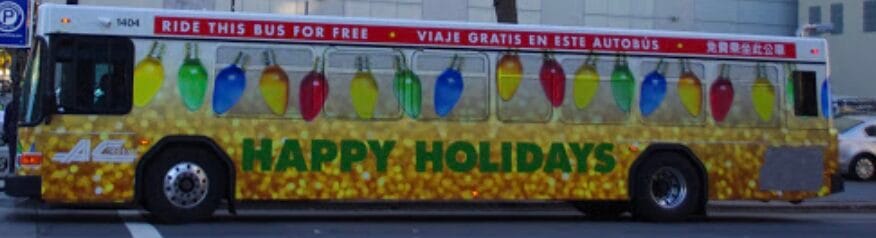
Alevizos became a legend by dressing as Santa Claus and wheeling through the East Bay in an AC-Transit holiday-themed decorated bus.
Oakland Tribune 1964
He started playing Santa Claus in 1933 for the Shrine, Richmond Kiwanis Club, and at the Division 3 Christmas parties.
Oakland Tribune 1975
He also played Abraham Lincoln, Christopher Columbus, and Uncle Sam on the appropriate year dates. However, beginning in 1933, Santa Claus remained his most extended running role.
Oakland’s Early ‘Jitney King’
Oakland Tribune May 23, 1971
A transportation pioneer in the East Bay, Nichols P. Alevizos, 1921 started a jitney bus service. The major Oakland Jitney route was 7th Street from Pine Street to Clay Street. There were 16 jitneys and 16 drivers on the run, with 15 in use each day and the 16th taking the day off.
Alevizos organized a jitney association in 1924 and became its first and only president. In 1928, the association bought eight Model A Ford buses and named them West Oakland Motor Bus Lines.
Oakland Tribune 1929
In 1935, Alevizos sold the company to the Key System. Part of the deal made by Alfred J. Lundberg, Key System president, was for Alevizos to have a lifetime supervisor job with the company.
Oakland Tribune 1934
He served as superintendent of the Key System and later AC Transits Richmond Division. His career spanned 56 years.
Alevizos retired at the end of 1977 after a career that spanned over 56 years. He continued as Santa for two more years and passed away in April 2000.
History of the Holiday Bus
In 1963, AC Transit launched its first holiday-themed bus, the “Candy Cane Express,” painted white and decorated with big red bows.
AC Transit Times
In the following years, the Holiday Bus became more elaborate. The vehicles were custom-painted and decorated with handmade wooden ornaments. By the mid-1960s, a full-size sleigh was installed on the roof, where “Santa” would ride.
There have been many versions of the Holiday Bus throughout the years. Decals and full custom vinyl wrap have replaced the custom paint jobs and bolted-on decorations.
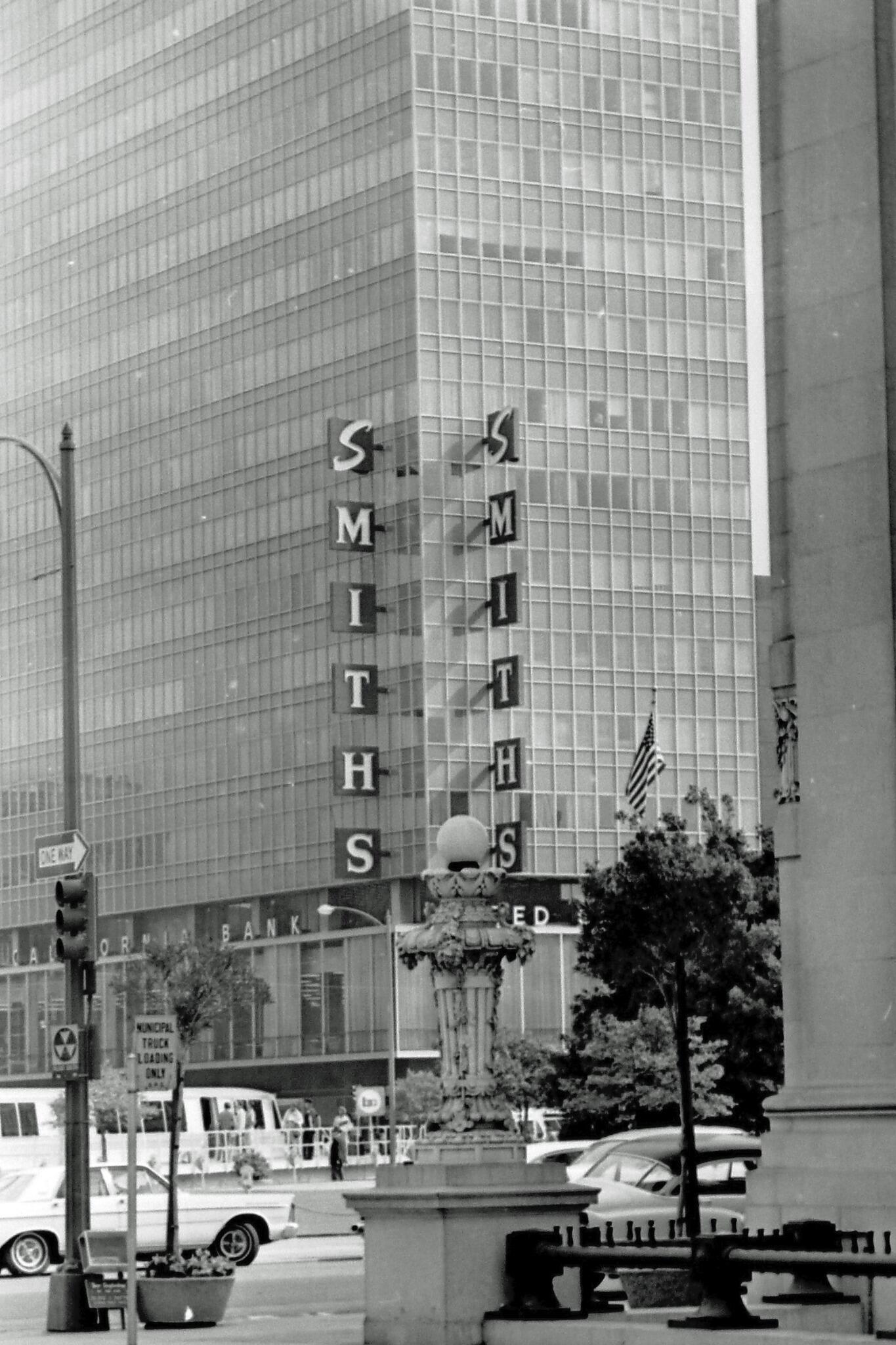
Originally called “The Famous Clothing Company.” Later it was renamed “Smith’s Money-Back Store and Money-Back Smith.” You probably knew it as Smith’s Department Store.
William Smith founded the first store in Oakland in 1885 (according to the Oakland Tribune)
Unique Nickname
“Money Refunded If Goods Are Not Satisfactory.”
Oakland Tribune
Willam “Money-Back” Smith
His friends, relatives, neighbors, and patrons were so used to the policy of ‘money-back” being associated with William Smith that became his nickname.
First Store
The first store was on Broadway, between 7th and 8th Street, later moving one block to 9th Street.
Brilliant Opening
Oakland Tribune
The Famous Clothing Company proprietors held a grand opening reception on March 16, 1892, at 909 and 911 Broadway.
The Berkeley Gazette March 18, 1904
In 1896, Smith chose a new location at 10th and Washington, where the firm remained until 1912.
They then moved to 12th and Washington, which was enlarged and modernized several times.
1935-Blake Estate Co. building (the Blake Block) W. F. Woolworth, Money Back Smith inM.L. Cohen Co., photographers, for Downtown Property Owners Association, Inc. :Permission to use this image must be obtained from the Oakland Public Library, Oakland History Room.
Another New Location
Circa 1933 – M. K. Blake building (the Blake Block), southwest corner of 12th Street and Washington Money Back Smith in view. M.L. Cohen Co., photographers, for Downtown Property Owners Association, Inc. Oakland Public Library, Oakland History Room.
By 1912 the store was located at 12th and Washington Streets, and it was called “Money-Back Smith.”
Circa 1935 -M. K. Blake building (the Blake Block),.12th and Washington Money Back Smith in view. Downtown Property Owner’s Association. Volume 4. . M.L. Cohen Co., photographers, for Downtown Property Owners Association, Inc.
“Charge It” Plan
Oakland Tribune 1940
Breaking all precedents, Money-Back Smiths had for 54 years had a “cash only” policy offered a liberal 90-day charge plan. The plan had no downpayment, no interest, and no carrying charge.
More than 10,000 Eastbay residents opened accounts in the first six months.
“Charge it!”
They made the term “Charge it” a common word in the vocabulary. Smith declared September 27, 1940
55th Anniversary
“Founded back in 1886 – literally the horse and buggy days of the city, the store has grown with Oakland.”
Oakland Tribune September 27, 1940
“We Couldn’t possibly cut a birthday cake large enough for all the of our customers, and so were cutting prices instead.”
Expansion
Blake Block [ SW corner of 12th and Washington. Creator/Contributor:Cohen, Moses L., 1884-1975. Downtown Property Owners Association (Oakland, Calif.). Date:1944
In 1941 the store embarked on a program of remodeling and expansion that doubled its size. Two additional floors were added, which gave them three floors for selling merchandise.
Oakland Tribune Dec 1951
In 1945, the store acquired 30,000 Sq.Ft. of additional space in the Blake Building on Washington Street.
M. K. Blake Estate Co. building (the Blake Block), southwest corner of 12th and Washington Streets. Smith’s in view. – 1949, Jun. 27 . Camera Corner, photographers, for Downtown Property Owners Association, Inc. RIGHTS:Permission to use this image must be obtained from the Oakland Public Library, Oakland History Room.
First Western Bank Building
Oakland Tribune 1955
In 1955 the old Henshaw Building at 14th and Broadway, built-in 1891, was demolished. The Henshaw building housed the MacDonough Theatre, one of Oakland’s first legitimate showhouses.
The First Western Bank Building was completed in 1958.
In March 1886, the Board of Supervisors created a new school district. That took from portions of the Piedmont, Peralta, and Fruitvale districts representing about 44 children.
Hays Canyon Schoolhouse Students pose with their teacher, in this photo and of the six children sitting down. Walter Wood is 2nd from the left, his brother Alfred Wood is 4th from the left, Harry W. Logan is seated on the far right, and his brother Maurice Logan (the painter) is standing on the far right. The Logans and the Woods lived at Lake Temescal. c 1900-1910 Oakland History Room
The new district was called the Hays School District in honor of the late Colonel John Coffee Hays.
The superintendent appointed the following residents of the area as trustees:
W.H. Mead
J.H. Medau
Mrs. Susan Hays
Land Donated
Hetty S. Henshaw gave the district the land for the school. The Montclair Firehouse was built on the spot in 1927, using the front part of the lot.
Oakland Tribune July 16, 1886
New School House Built
Requests for bids to build the school were made in July of 1886.
Oakland Tribune July 1886
The completed school was small at only 32×36 feet, with just one classroom. It was Gothic in design with a graceful-looking bell tower. It had two entrances, one for the boys and the other for the girls, with each entry having a 6×6 vestibule. The sash bars of the windows are all horizontal, copying the style of European schools.
Oakland Tribune July 07, 1886
The construction cost about $2,500 and took about two months to build.
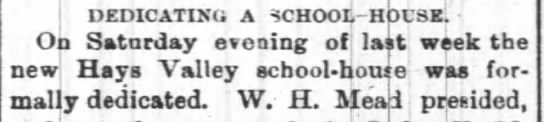
The dedication of the school was held in October 1886. It was attended by most of the families that lived in the area. Judge EM Gibson and W.H Mead made opening remarks. Some of the families in attendance:
The students from the school provided entertainment under the direction of their teacher Miss Lucy Law. The following students performed:
Clara Gibson
Gussie Gibson
Carrie Mead
Daisy Mead
Susie Mead
Mattie Mead
Edith Medau
Louise Medau
Oakland Tribune February 11, 1888
Oakland Tribune November 23, 1889
Graduation 1901
Hays School was the scene of brightness and beauty on Friday, June 14, 1901. Friends and family gathered to witness the closing exercises. The four graduates were:
Jessie Logan
Robert Shepherd
August Carson
Scott Monroe
Oakland Tribune June 1901
School Trustees
In 1904, Mr. S. Morrell and Mr. Johnson were appointed to fill the vacancies caused by George Hunt’s and G.W. Logan’s removal.
Attendance for the year ending 1911 for the Hays School was 11 students.
Oakland Tribune August 01, 1911
School Closes
The school was closed around 1913, and the building was demolished. It was probably due to the Oakland, Antioch, and Eastern Railway construction, later known as the Sacramento Northern. For more on the Sacramento Northern, please go here. The East Bay Hills Project
Montclair Firehouse
The Montclair firehouse was built on the same site in 1927. The storybook-style building was designed by Eldred E. Edwards of the Oakland Public Works Department.
Storybook firehouse on Moraga Avenue in the Montclair district of Oakland, California. 1934, ohrphoto.districts.031. Oakland. Buildings Oakland Public Library, Oakland History Room.
More on the mansions that once graced the streets of Oakland
Koa Hall – Bailey Mansion
W. H. Bailey, who owned plantations in Hawaii, hired W.J. Mathews to design his home, costing $70,000 to build circa 1889.
Bailey Mansion on Jackson Street – 1898Oliver Family Photograph Collections Bancroft Library http://ark.cdlib.org/ark:/13030/kt0n39q1p1
The main hall’s woodwork was made of beautiful koa from the Hawaiian Islands. Koa carvings were also found by the main staircase. The reception room’s woodwork on one side of the hall was bird’ s-eye maple. Antique oak was used in the library and the dining room.
Oakland Tribune May 31, 1891
It was converted into a rooming or boarding house.’
Oakland Tribune March 11, 1916
The old mansion was razed in the late 1920s, and the Hotel Lakehurst was built.
Oakland Tribune Feb 02, 1930
It is now called Lakehurst Hall.
Location: 1369 Jackson St, now 1569 Jackson Street, at the corner of 17th Street.
The three-story, five-bedroom home was built in 1872 by Dr. Samuel Merritt.
In 1874, Roland Geir Brown, a capitalist, purchased the home. Brown was one of the early members of the San Francisco Stock Exchange.
Mr. Brown sold sewing machines for Grover and Baker. The Oakland Tribune reports that Brown was one of the wealthiest men in 19th-century Oakland.
Roland G Brown with two adults – in the carriage. – Courtesy of UC Berkeley, Bancroft Library – http://www.oac.cdlib.org/ark:/13030/kt409nc89b/?order=1
The Brown home was less than a block from Lake Merritt, before the lake shore was filled in.
Old Brown Home – undated (maybe 1956)
When President William McKinley was in the Bay Area for a week in May 1901, he visited the Brown home.
Oakland Tribune July 25, 1956
Lilian Brown, Roland’s daughter, lived in the mansion until her death in 1955.
The old Brown home at 1889 Jackson Street was demolished in 1956 to accommodate a parking lot.
Location: 1889 Jackson – between 17th and 19th Streets
“Aloha, nui,” or “Love be unto you.” It is carved above one of the entrances
Samuel T. Alexander came to Oakland from Hawaii in the early 1880s. He was one of the founders of Alexander & Baldwin, an American company that cultivated sugar cane.
Oakland Tribune
In 1882, Alexander purchased a lot on the northwest corner of Sixteenth and Filbert for $6,000.
Artistic Homes of California
Artistic Homes of California
The three-story Queen Anne-style home was designed by Clinton Day and was completed in 1883 at the cost of $20.000
Move to Piedmont
The family lived there until 1912 when Mrs. Alexander moved to Piedmont to be closer to her son, Wallace Alexander.
Rooming House
Sometime after 1912, the mansion was converted to a rooming house, and rooms were rented out until the mid-1960s.
Oakland Tribune 1919
Sanborn Fire Insurance Map from Oakland, Alameda County, California – Vol 1 1903
New Life for Old Mansion
In 1967, the once venerable mansion stood deserted, and in despair, its boarded or broken windows were scheduled to be demolished.
The Oak Center Neighborhood Association members decided that the old mansion could be given a facelift and become a community “Neighborhood House.” Thus, demolition was halted.
Oakland Tribune 1967
They visualized a rehabilitated building with office space for the Oak Center Association, a children’s library and study hall, an adult library and reading room, a large all-purpose room for meetings and socials, and a room for individual and group counseling.
Vandals Strike
The group succeeded in saving the old mansion from the wreckers, only to have it nearly demolished anyway –by vandals. The house was broken into, ruined beyond repair, and finally demolished in 1968.
It was built in 1865, the 14-room house of rococo architecture. The barn had room for ten horses and room for 20 tons of hay.
Oakland Tribune
The house had 14 rooms made of redwood. The barn had room for 10 horses
Oakland Tribune
The mansion had a wood and coal furnace, and the radiators are believed to have been the earliest models of that kind in the country. The rooms were paneled with massive doors 9 feet high. Beautiful mirrors adorned the wall.
Oakland Tribune
It was reported that Susan B. Anthony once slept there.
Sanborn Fire Insurance Map from Oakland, Alameda County, California – Vol 2 1903
The house and barn property were purchased by Marston Campbell, Jr, as an investment. It was torn down in 1948.
Edward P. Flint, a land developer and San Francisco businessman, moved to Oakland in 1860. He lived at 13th and Clay before moving to this house.
Oakland Tribune 1964
The site where he built the house at 447 Orange Street was part of a larger parcel he subdivided in Adams Point.
After Flint died, Admiral Thomas S. Phelps, a veteran of the Spanish-American War, purchased the property. In 1939, M.A. Marquard purchased the propertyand lived in the house until 1964.
The house was demolished in 1964 and replaced with a “modern 28-unit apartment building.
The new structure has 15 two-bedroom and 12 one-bedroom apartments, plus a penthouse. Al Colossi designed the building. It is located at 447 Orange Street.
Mr. and Mrs. Marquard lived in the penthouse of the new apartment.
The heavy missile, which neighbors said had hurled through the air like a
“shell from a cannon.”
Oakland Tribune October 28, 1931
A 40-pound rock, blasted from the hills above Millsmont, was hurled half a mile and crashed through the roof and dining room ceiling at the home of Fred Bailey, 4017 Altamont Avenue.
The rock was blasted from the nearby Heafey-Moore quarry.
“There is little doubt the rock came from the quarry, where men were blasting.”
A “strange-urge” told Mrs. Bailey to leave their home, and she did go. She left the house at 4:30 with her daughter and went downtown.
“every time I went into the dining room, something told me I shouldn’t be there.” Mrs. Bailey said
Oakland Tribune October 28, 1931
They returned home to find it in shambles. There was an eight-foot hole in the ceiling of the dining room. The rock landed on the couch/bed that their daughter used.
On March 18, 1919, Mrs.George D. Greenwood was killed instantly when a bomb exploded in the family home garden overlooking Lake Merritt. Her husband was the Vice-President of the Savings Union Bank of San Francisco.
Killed Instantly
It is believed that Mrs. Greenwood found the bomb and picked it up, causing it to explode.
Mrs. Greenwood’s body was torn apart and hurled ten-feet across the garden by the force of the explosion. Her clothing was stripped from her body and hung from the trees or was scattered on the lawn.
All windows on two sides of the Greenwood home were shattered.
Threats Sent to Other Families
The Greenwood family wasn’t the only Eastbay family to have received letters threatening death unless specific amounts of money were handed over.
Other families included:
Kenneth E. Lowden – 274 19th Street
Mrs. E.A. Julian – Piedmont
According to the police, a letter demanding $5,000 and threatening to destroy his home with dynamite was sent to Greenwood in January of 1918. The “C.C. of C” signed the letter, which stands for the Cat’s Claw of California.
Oakland Tribune March 21, 1919
The Greenwood explosion was the third in a series attributed to a gang supposed to have dynamited Governor William D. Stephens home and one other.
An unexploded bomb was found in the yard of N. Campagna of Berkeley the week before.
Society Leader
SF Examiner June 12, 1893
Mrs. George D. Greenwood was considered “society royal” in Oakland and San Francisco, where her parents and husbands were pioneers.
Tubbs Hotel
She was one of the Tubbs girls, the daughters of the late Hiram Tubbs, early capitalist, and owner of the famous old Tubbs Hotel.
Oakland Tribune 1891
The daughters were Mrs. Greenwood, formerly Miss May Tubbs, Mrs. William G. Henshaw, Mrs. Grace Tubbs Henshaw, and Mrs. Edward M. Hall.
No Results
Oakland Tribune March 1919
Police investigations, which continued for more than a year after the tragedy, resulted in the clearing of the mystery surrounding the bomb.
Hanford Kings County Sentinel May 08, 1919
The police arrested many suspects, none were charged.
New Wife
Oakland Tribune Sept 1922
Mr. Greenwood married Gertrude Vincent in late 1922.
Greenwood Home
The Greenwood home was located at the corner of 19th Street and Jackson at 1399 Jackson Street (later changed to 1899 Jackson). The Greenwoods lived there from about 1896 to 1920.
The Greenwood Home at the corner of Jackson and 19th Streets. Photo by Frank Rodolph
Oakland Tribune May 12, 1936
In 1936 the house was remodeled and became the new home of the Oakland University Club.
“We are building this clubhouse beyond our immediate requirement but with an eye to the future”
Mrs. E.T. Jepson Nov 08, 1925
A New Clubhouse
Press release
“A very handsome $10,000 structure is planned for the Montclair Clubhouse. It will be 109 by 40 feet and will contain a large auditorium, stage, dressing room, dining room, kitchen, check room, restroom, and basement space, which will be utilized as billiard room.”
Oakland Tribune
Construction Started
The groundbreaking celebration was held in March of 1925 at the junction of Thorn Road (now Thornhill Drive) and Mountain Blvd.
Members of the Montclair Improvement Club inNovember of 1925 began constructing the new Clubhouse.
New Clubhouse Opens
In March of 1926, the Montclair Improvement Club held the $ 20,000 Montclair Community Clubhouse formal dedication.
The one-story structure is of Spanish architecture. Features include an auditorium with stage and fireplace, dining and reception rooms, and an electrically equipped kitchen.
Montclarion
John Perona donated his services as a builder. Club members’ labor contributions reduced the cost of construction.
They also planned to have tennis and handball courts, a playground for children, and a golf course.
In March 1926, the Montclair Improvement Club held its first dance at the new Clubhouse.
A Bit of History
The beginnings of the Montclair Improvement Club can be traced back to as early as 1923.
Oakland Tribune March 1923
After a few years, it became the Montclair Bussiness Assoc.
Montclarion
Membership comprised residents of Montclair, Merriewood, and Forest Park.
Copy of Newsletter
The Women’s Auxiliary to the Montclair Improvement Club was also formed in 1923. The name was changed to Montclair Women’s Club in 1925 when it became affiliated with the California Federation of Women’s Clubs
Montclair Women’s Clubhouse
In May 1928, the women’s club purchased the Clubhouse from Montclair Improvement Club.
Oakland Tribune 1928
They held their first dance in August of 1928.
Clubhouse Damaged in Fire
In November of 1928, a fire damaged the interior of the Clubhouse.
Oakland Tribune November 10, 1928
Clubhouse is Sold
The Montclair Women’s Club was sold in 1996. From 1996 until 2015, it was an events center called the Montclair Women’s Cultural Arts Club.