Posted in Buildings, Schools, Then and Now

Then & Now – Oakland Schools Part 3

 I hope to show Then and Now images of Oakland Schools in this series of posts.  Along with a bit of the history of each school, I highlight. Some photos are in the form of drawings or postcards or from the pages of history books. 

Note: Piecing together the history of some of the older schools is sometimes tricky. I do this all at home and online — a work in progress for some. I have been updating my posts when I find something new. Let me know of any mistakes or additions.

Updated December 26, 2023

E. Morris Cox School (Elmhurst Annex)

The new Elmhurst Annex Elementary School was completed in Oct 1926. Howard Schroeder designed the Italian Renaissance-style building. The new school contained thirteen classrooms, a kindergarten, and an assembly hall. It cost $140,000 to build. The school is located at 98th Avenue and Sunnyside Street.

Oakland Tribune 1926
E Morris Cox School. Graham Photo, Courtesy BAERA, Western Railway Museum Archives

Renamed

The Elmhurst Annex school was renamed to honor E. Morris Cox, who died in 1925. Cox was the Assistant Superintendent of Schools.

In 1960 a new building was added to the school.

Located at 9860 Sunnyside Street

  • E.Morris Cox School Dedicated – Oakland Tribune November 10, 1926
  • Cox Academy Website – OUSD

Garfield School

Garfield Grammar School opened in March of 1887 with two seventh and eighth classes. The teachers will be Miss Murray and Miss Ellen Gibbs.

The school was named after the 20th U.S. President, James A. Garfield, who was assassinated in 1881.

Oakland Daily Evening Tribune March 24, 1887

The school was designed by John & T.D. Newsom (Newsom Brothers)

Garfield School 1893

In 1910 Miss Ellen Gibbs retired after 16 years as the principal of Garfield Grammar School.

Garfield School circa 1905
OMCA
Harry Courtright | Commercial Photo View

Fire

In 1926 a suspected arson fire destroyed the school built in the 1890s. The school was a combined elementary and junior high. This was the fourth school to be destroyed by fire in nine months.

Oakland Tribune September 11, 1924

New School Built

The school board approved a new Tudor-style building. Miller and Warnecke designed the new three-building with 26 classrooms.

Oakland Tribune December 16, 1925

A cornerstone for the new school was laid in Sept of 1926.

Oakland Tribune September 28, 1926

1959

Bids were open to build a new school on the present site.

Oakland Tribune 1959

Located at 1640 22nd Avenue, Oakland, CA, 94606

Jefferson School

John J Donovan and Washington J Miller designed Jefferson School. The school was built in 1912.

School Architecture: Principles and Practices
By John Joseph Donovan 1921
School Architecture: Principles and Practices
By John Joseph Donovan 1921

In 1959 bids were open to build a new school at the same site. The demolition of the old building was in 1960.

Oakland Tribune May 27, 1959

Dedication ceremonies were held in January 1961 for the new $560,000 school. Jefferson was the 31st project to be dedicated of the 51 proposed in the 1956 school bond issue.

Jefferson School – 2035 40th Avenue, Oakland, CA

It is now the Global Family Elementary, a TK – 5th-grade dual immersion school located in the East Oakland-Fruitvale corridor near Foothill Avenue. Our dedicated staff prepares students to be bilingual and bi-literate to meet the challenges of the 21st century. 

Lazear School

Lazear School, designated initially as the Park and Division School, was built in 1913-1914. The school cost $75 595. Fred Voorhees was the Architect.

The school was named after Dr. Jesse Lazear, an American physician and commission member that proved that a mosquito transmits the infectious agent of yellow fever.

New School

In 1959 a new school with 12 classrooms, a kindergarten, a library, and offices was built to replace the old one. The new school cost $162,456.

824 29th Avenue, Oakland, CA, 94601

Lazear Today

It is now Lazear Charter Academy 

The End

Updated October 21, 2023

Posted in Buildings, Schools, Then and Now

Then & Now – Oakland Schools Part 2

I hope to show Then and Now images of Oakland Schools in this series of posts. Along with a bit of the history of each school, I highlight. Some photos are in the form of drawings or postcards or from the pages of history books.

Note: Piecing together the history of some of the older schools is sometimes tricky. I do this all at home and online — a work in progress for some. I have been updating my posts when I find something new. Let me know of any mistakes or additions.

Campbell Primary School

Campbell Primary School started put as the Grove Street School. The name was changed in 1906 to Campbell School for Fred Campbell, the superintendent of Oakland schools from 1870-1870 and 1886-1890. He was the state superintendent of schools from 1880-1883.

Campbell School looked in 1887 Oakland Tribune June 09, 1926

His daughter Mary Campbell was the school’s principal from 1898-1926.

Miss Mary Campbell – Oakland Tribune Jun 9, 1926

In 1907 a new school was built. The Mission Style school was designed by Architect F.E. Voorhees and cost $38,000. It had seven classrooms and an office for the principal.

Oakland Tribune Mar 1907

1954 the school was closed because it was not earthquake-safe, and the students were sent to Tompkins School. The school was sold and demolished in 1954. A commercial building was built on the site.

More Info:

The school was located at 416 Grove Street.

Cleveland School

In 1912 the first drawing for a new Peralta Heights school was submitted to the school board. John J. Donovan and Shafer & Wilde were the architects.    Donovan designed many schools for the district.

Peralta Heights is a small neighborhood in what is now known as Cleveland Heights.

Bids to build the school were submitted in 1912, based on the below photo. They held a formal opening of the school in Jan of 1914.

Oakland Tribune Jan 6, 1914
Oakland Tribune Mar 29, 1914

The old school building stood in 1973 and was finally replaced with a new facility in 1977.

Oakland_Tribune_Mon__Mar_26__1973_
Oakland Tribune March 26, 1973

Cleveland Today

Cleveland School Today – Google Maps

More Info:

California Distinguished School for 2020

“serves the very diverse and historically underserved city of Oakland, with a large percentage of students living in poverty and a large percentage of English learner”

Release California Department of Education

Press Release – OUSD

Cleveland Elementary School is located at 745 Cleveland Street.

Cole Grammar School

Cole Grammar School was opened in 1878 in West Oakland on 10th Street between Union and Poplar Stree. The plans called for a two-story, 14-room building.

Cole School – Oakland and Surroundings 1885

It was named for Rector E. Cole, an early Oakland dentist and member of the city council, and member and then president of the Oakland Board of Education.

Jack London attended Cole starting in 1887. He graduated 8th grade in 1891.

Front Doors of the Cole School Building with several children standing on the sidewalk in 1908 Huntington Digital Library
Class of 1909
Class of 1910

School Fire

In Dec 1923, the school was destroyed in a six-alarm fire where one fireman lost his life, and six others were injured. The fire was deliberately set by a”firebug.” A suspicious fire was a reporter at Garfield School at 23rd and Foothill Blvd.

Cole School

The cornerstone for a new school was laid in May 1925, and the new two-story school was dedicated in April 1926.

More Info:

Cole School was the headquarters of the Chief of Police from 2013-2021 (?.) As of 2023, a new OUSD administration building in under construction.

Cole School Today – Google Maps

Cole School was located at 1011 Union Street.

  • Central Administrative Offices Cole Campus – OUSD

Piedmont Avenue School

The Piedmont Avenue School, as seen below, was built in 1891.

Oakland Tribune February 13, 1892

Before that, a two-room schoolhouse was closer to the Mountain View Cemetery. Classes we held for a time at the home of G.W. Hume, who lived in a large estate where the school is located now.

Both children from Piedmont and Oakland used the school at that time. The building was designed by William Kirk and cost about $10,000 to build. The school had a bell tower with a 350-pound bell. There was a large assembly room, a library, a hothouse for plants, classrooms on both floors and a large lighted basement where the children could play during wet weather.

Oakland Tribune February  20, 1892

The school was dedicated on Washington’s Birthday in 1892.

Engraving of the Piedmont District School at Webster Avenue in Oakland, Alameda County, California, from the book “Illustrated album of Alameda County, California” by Jos, 1893. Alex Colquhoun. Courtesy Internet Archive. (Photo by Smith Collection/Gado/Getty Images)

School Fire

In July of 1938, while the students were on summer break, the school was destroyed by an arson fire. Ten firemen were injured, four of them seriously.

The new school was dedicated in March of 1941 with funds provided by “The Living New Deal” Works Progress Administration (WPA).

This Art Deco school building has an auditorium, library, kindergarten classroom, kitchen, offices, and regular classrooms. There is still a WPA sidewalk marker in front of the school.

More Info:

Prescott School

Prescott School was established in 1866 as a one-room primary school. It was named after William H. Prescott, a historian, and was located at Ninth and Campbell Streets on dirt roads surrounded by woods.

Oakland Tribune 1877

In 1869 a new two-story building with four classrooms on each floor, ‘the largest, and it was the most up- to- date school building in Oakland,’ with C. W. Brodt as principal, with a salary of $150 per month.

Prescott school building was heavily damaged in the historic 1906 San Francisco Earthquake.


Prescott School with damage from the 1906 earthquake
UC Berkeley, Bancroft Library
Permalink: https://calisphere.org/item/ark:/13030/hb1m3nb284/

New School

Prescott Primary School was constructed in a record time of 187 workdays by Lawton & Vezey, a local contractor.

Oakland Tribune October 24, 192


Oakland Tribune October 24, 1916

The new school was a two-story Spanish-style steel-framed building with a basement and seventeen classrooms.

accepted by the school board, who considered it one of the best in the recent school buildings”

Oakland School Board – October 05, 1926

The exterior of Prescott School circa 1918
Towns (Royal E.) Papers
Oakland Public Library, African American Museum
prescott-school-playground-west_1_0f2ee96ce0f6fda0b21a28a70d72cea6
Prescott School 9th & Campbell Streets – Cheney Photo Advertising Company c 1919

Ida Louise Jackson, Oakland’s first African-American teacher, taught there in 1925 — 13 years before any other school hired a black teacher.

Unsafe and Condemned


Oakland Tribune 1958

In 1954 Prescott Junior High (name change?) was condemned for being dangerous to the students. At that time, there was no budget to replace it.

Prescott Today

Prescott is located at 920 Campbell St.


Prescott School Today – Google Maps

The school has been operating under the name PLACE @ Prescott (Preparatory Literary Academy of Cultural Excellence @ Prescott) since 2006, serving Kindergarten through 5th-grade children

More Info:

Swett Grammar School

Swett School was located at 12th Avenue and East 19th Street.

Views of Oakland 1893
Swett School – 1906 earthquake damage
Owning Institution: UC Berkeley, Bancroft Library
Permalink: https://calisphere.org/item/ark:/13030/hb9199p3sm/

Woodrow Wilson Junior High

Woodrow Wilson Junior High started as Mosswood Junior High in August of 1923. It was located at the corner of 48th and Webster Streets. In 1924 the school’s name was changed.

Oakland Tribune Feb 19, 1924

In 1926 they laid the cornerstone for a new school.

Oakland Tribune Oct 28, 1926
Oakland Tribune Aug 20, 1927
Woodrow Wilson Junior circa the 1970s

In the early 1970s, Woodrow Wilson Junior High School was demolished, and a new school was built. In the mid-1970s, the school was renamed the Verdese Carter Middle School.

Demolition of Woodrow Wilson School in the 1970s
from Adrienne Broach
Demolition of Woodrow Wilson School in the 1970s
from Adrienne Broach

Woodrow Wilson Today

The School Today Google Maps

In 2007 the Oakland Unified school district opened its first school that enrolls only immigrant students. The Oakland International High School is modeled after international high schools in New York City for newcomers to the United States. The school was still open in 2019.

More Info:

The school is located at 4521 Webster St.

  • Oakland International High School – OUSD
  • West Coast District Uses East Coast Model – August 2007

Updated August 2023

The End

Posted in Black History, Buildings, Business

Wrecker Uses Sherman Tank To…

Project Gateway – West Oakland

The world’s largest and fully mechanized mail handling facility designed to serve central California and the Pacific ocean area

Postmaster General – Aug 1959

It was announced that the facility would be built on a 12-block site in West Oakland bounded by Peralta, 7th, Wood Streets, and the Southern Pacific railroad yards.

Oakland Tribune August 26, 1959

The postmaster general officially named the Oakland project “Project Gateway”

Oakland Tribune August 26, 1959

Major Problems

City officials were excited that construction would begin in about one year. They expected an Oakland payroll of 750 workers and the clearing of some 20 acres of sub-standard homes for a significant redevelopment project.

Oakland Tribune August 30, 1959

Oakland Mayor Clifford E. Rishell noted that the post office project presents some significant problems, chiefly relocating 300 families (about 1000 people) in the project area.

Oakland Tribune July 25, 1965

The Oakland Redevelopment Agency was in charge of the relocation. A survey at the time determined that half of the 300 families had moderate incomes, permitting them to rent or purchase a home in other sections of the city. The other half will probably require public housing.

The job we face isn’t easy, but it isn’t impossible

Arthur Hoff – Oakland Redevelopment Agency

One of West Oakland’s most revered landmarks was lost when the New Century Recreation Center and the adjoining school property at Atlantic, Pacific, and Peralta Avenues were razed.

The project would also destroy a junkyard, a few businesses, and McFeely School, which opened in 1949.

Evictions

In a March 1960 special meeting of city and postal officials, 34 families were told they had already received eviction notices. The families lived in homes already sold to the government by Southern Pacific. Twenty-one families had already found new homes.

August 01, 1960, was when they were to begin clearing the site.

Oakland Tribune July 19, 1960

A squadron of bulldozers was set to plow into the 12-block block of buildings. Twelve parcels of the 187 total had been acquired in negotiation. Commendation orders were entered for the holdouts.

12 Blocks Cleared For the Postal Center

Sherman Tank

The postal officials were perplexed when building wrecker Aldo S. Allen submitted a low bid of $64,000 to clear the 20-acre site for Project Gateway. He was $10,000 lower than the next lowest bid and $50,000 lower than the highest bid.

I got an idea” Allen a one time midget car racer explained.

Aldo S. Allen – 81st Ave Oakland CA

He planned to spend $2,000 on a surplus Sherman Tank of World War II vintage, a 73,000-pound dreadnaught powered by a 500 horsepower engine. The tank would be much more powerful, faster, and safer.

He was Right!

Aldo climbed into the tank in front of a row of six houses. He first practiced on a tree.

SNAP! Down went the tree.

Oakland Tribune August 16, 1960

Without pausing, he went towards the first house and bore a tunnel through it. The second story remained intact. Again, he aimed for the home. There was a roar, and the second story came down, burying the tank momentarily.

10 Minutes Flat! The time to clear the first house

Oakland Tribune August 16, 1960

It took 90 minutes to flatten and remove all six houses

Oakland Tribune August 16, 1960

Before and After

Oakland Tribune August 17, 1960
The Daily News Texan August 16, 1960

The post office Site is Now A Dump

Oakland Tribune July 15, 1963

1963, after five years of post office promises, the city demanded action. The site had become a 12-block dumping ground, and the city was losing $22,000 in tax dollars and $50,000 in additional school taxes. They were told that construction was set to begin in 1964. By July 1967, the building was nearly one-third complete. The belated Effects of a Long Wet Winter moved the opening date to March 1969.

Oakland Tribune August 26, 1984

More Info:

The End

Posted in Buildings, Schools, Then and Now

Then & Now – Oakland Schools Part 1 – A

My 100th post!

This is the first in a series of posts on Oakland Schools.

I hope to display ‘Then and Now’ images of most of the schools, along with a brief history of each one I feature. Some photos are in the form of drawings, postcards, or from the pages of history books.

Note: Piecing together the history of some older schools can be a challenging task. I do this all at home and online — a work in progress for some. I have been updating my posts when I find something new. Let me know of any mistakes or additions.

Updated September 20, 2020

Castlemont High School

In 1863, Frank Silva purchased 73 acres of land for a farm. Castlemont High now stands on his land.

Oakland Tribune October 19 19, 1965

Castlemont High School is in Oakland, California, United States, formerly known as East Oakland High School. The Castlemont name was chosen by a student vote. Castlemont High School was founded in 1929 in a building with a medieval-style design. The school is located at 8601 MacArthur Boulevard.

 Castlemont High was designed by Chester Miller and Carl Warneke, Oakland architects. Oakland Local Wiki – Castlemont High.

Castlemont Construction – Pouring the foundation.
Castlemont Under Construction

August 12 12, 1929, East Oakland High School opened for $670,000. Still, the name was short-lived; by a vote of the students and faculty in 1930, the name Castlemont was officially brought to prominence before being nationally designated the most beautiful school structure in the country.

Oakland TribuJuly 07y 07, 1929

The building’s main entrance is accessed from Foothill Blvd, down six steps to the reflection pool, then ascends six steps to the extended terrace and the four-entry solid redwood doors. The full length of Castlemont grounds adjacent to Foothill had been magnificently landscaped.

The building was replaced in 1961 as the old one was not earthquake-safe.

Castlemont is demolished
Castlemont is gone.

Castlemont Today

Google Maps
Google Maps

From 2004 to 2012, the large school housed three separate smaller schools, collectively known as the Castlemont Community of Small Schools, for eight years. The smaller schools were known by the names:

  1. Castlemont Leadership Preparatory High (10-12)
  2. Castlemont Business and Information Technology School (10-12) (CBITIS)
  3. East Oakland School of the Arts (10-12)

Dewey School

Dewey School was established as an elementary school at 38th Avenue and East 12th Street in 1899. It was a part of the Bray School District and the Fruitvale School District.

Oakland TribApril 28l 28, 1899

It was named after Admiral George Dewey, a hero of the Spanish-American War then being fought.

Dewey School circa 1916 Cheney Photo Advertising

In 1964, Dewey became the first continuation high school in Oakland. Below is how Dewey looked in 1964. In 1913, an addition was added to the original school, which was still in use in 1964.

Oakland TribJune 12e 12, 1964

Dewey is now located at 1111 2nd Ave, Oakland, CA, 94606

Franklin School

Oakland TribMarch 29rch 29, 1928

The Brooklyn School was a two-story building built in 1863-64 for $5,000.

Oakland, January 20, 1887

Brooklyn was annexed to Oakland in 1872. After the annexation, the nine-year-old school was renamed Franklin Grammar and Primary School.

Oakland Tribune Dec 30, 1874

An addition to the school was added in 1879 at a cost of $3,217.

OaklanDecember 30une DecembDecember 02

On December 02, 1902, the school was destroyed by fire.

Oakland Tribune, November 30,
Oakland Tribune April 18, 1906

The new school building was almost complete when the SF earthquake of 1906 struck. The brick and steelwork were done, and the building was ready for the roof. Once the school was finally completed, the total cost was $ 204,343.45.

Franklin Grammar School Cheney Photo Advertising circa 1912

In 1923, an oblong-shaped assembly hall was built at the rear of the school on 10th Avenue and E 16th Street. The cost is $40,0November 07

Oakland Tribune, November 07, 1926

In 1943, the school’s address was 1530 Ninth Avenue.

In 1953, the 1906 brick building was declared unsafe. In 1955, it was demolished to make way for a new building. The new school was a principal part of the Clinton Park Urban Renewal Project. The school opened in September 1956 and was dedicated in January 1957. The new school costs $467,000.

In 1956, a man, while remodeling his store, found an old report card from December 1875.

Oakland Tribune December 20, 1959
Franklin Today –

More Info:

The school is located at 915 Foothill Blvd

Fremont High School

The John. Fremont High School was the successor to Fruitvale High School and was organized in 1905 by Frank Rosseter.

Oakland Tribune May 02, 1910
Fremont High School circa 1915 – Cheney Photo Advertising

The old building was destroyed by fire on the night of January 01, 1930.


Oakland Tribune Jan 2, 1930
Oakland Tribune

New School

Oakland Tribune, May 29, 1931
Oakland Tribune April 19, 1932

The school reopened on April 19, 1932. was constructed with the assistance of the federal Public Works Administration (P.W.A.) funds.

Fremont Today

Fremont School

More Info:

Frick Junior High

Frick was constructed on the Boulevard between Baker and Bay View (now Foothill and 62nd). The school takes its name from W.P. Frick, who donated the lot on which the school is to be built. Was then part of the Lockwood march on March 17. The school was dedicated on September 20, 1909.

Oakland Tribune, September 20, 1908

The first school was kindergarten through the seventh grade. The building had eight rooms. With the rapid growth of the area around Frick School, it was decided to make Frick School a junior high in 1923.

Frick Grammar School circa 1915 – Cheney PhotMay 30rtising

New School

Oakland Tribune, May 30, 1926

In 1927, a new school was built on adjoining land and was called Frick Jr. High School. The style of the new building is a blend of Spanish and Moorish architecture.

Oakland Tribune June 05, 1927

Another New School

In 1953, it was determined that the 1927 building was an earthquake risk. In 1957, the ground was broken for a new school fronting Brann Street. The old building was razed during the summer of 1960. The present school has been in use since the 1960-61 academic year.

It is now called Frick Impact Academy

More Info:

Hamilton Junior High School

Alexander Hamilton Junior High was built in 1922. The school is located at 2101 35th Avenue.

It was named after Calvin Simmons sometime in the early to mid-1980s. The school was renamed United for Success Academy in 2006.

Google Maps

More Info

Horace Mann Grammar School

Horace Mann was built between 1910 and 1912. The school is located at 5222 Ygnacio Avenue. It was initially known as Melrose Heights School.

Horace Mann Grammar School

Groundbreaking for the new Horace Mann school, which was deemed not earthquake-safe, took place in 1959. The new school was formally dedicated in 1961.

Oakland Tribune, May 11, 1959

More Info:

Sequoia Elementary School

Sequoia Elementary School is located on Lincoln Avenue at Scenic Avenue. It was built in 1910. A. M. Hammond was the first principal. The building below is facing Scenic Avenue. The school’s address is 3730 Lincoln Avenue.

Cheney Photo Advertising Company, circa 1910

In 1926, a new school building was constructed adjacent to the original. The new building will have 13 to 14 rooms and an auditorium. It faced Lincoln Avenue, as seen below.

The original building was razed to make room for a new $235,880 addition, which added seven classrooms.

Oakland Tribune Nov 28, 1958
Sequoia School today. google maps

More Info:

Please see Part 1 B for University High School

The End

Posted in History, Schools, Then and Now

Then & Now – Old Lockwood School

Updated August 2024

Oakland Tribune Oct 10, 1965, and Pg.2

In 1858, Miss Julia Aldrich was contracted to run a small private school on Isaac (Issac) Yoakum’s farm. Yoakum had built his house on the site of the present Lockwood School. The house was moved and replaced with a small building to be used as a school (see above).

The schoolhouse remained in use for another 42 years, with a small addition in 1892.

The school was located at the intersection of East 14th Street (County Road No. 1525 and now International Blvd), Mary Street, then 68th Avenue, and later 69th Avenue.

Map from 1912 – the red line is East 14th (now International Blvd)

In the first year, Lockwood had twelve students enrolled.

Twenty-eight boys and ten girls were enrolled in the school in February 1876. Alonzo Crawford was the teacher.

Oakland Tribune Mar 1, 1876

In August 1876 (typo in the newspaper), 20 boys and 21 girls were enrolled.

Oakland Tribune Aug 22, 1876
  • The Damon Family owned a general store at the corner of E.14th & 66th
  • The Kinsell Family lived on 94th Avenue just below E. 14th
  • The A.H. Merritt family lived on 66th Avenue
  • The Moss home was at 82nd and Foothill
  • The Silva’s owned a saloon at 84th and E. 14th

New School – 1902

The new school was built on the corner of East 14th Street and 68th Avenue in 1902. Charles H. Greenman was the principal. The school was demolished (I need to verify this) in 1936.

Oakland Tribune Nov 20, 1902
The Oakland Tribune Collection, the Oakland Museum of California Gift of ANG Newspapers circa 1917

Greenman died while fighting a fire in the school playground in 1919. In the 1950s, they named the athletic field after Greenman.

Oakland Tribune Dec 7, 1909

Across from the school was the 282-acre dairy belonging to William Manchido. The big pasture was later used as the landing field of Weldon Cooke, an early Oakland aviator. In 1910, Wickham Havens subdivided the land into what we now know as Havenscourt.

Oakland Tribune Nov 03, 1957

Old School is Sold – 1903

Oakland Tribune Feb 3, 1903

Class of 1904

Oakland Tribune May 1948

Lockwood Junior High

In 1913, Supervising Architect J.J. Donovan announced that a new Lockwood school building would be built at East 14th between 66th and 68th Avenues.

The school was to be one story in height, built in the early California style around a courtyard and Mission architecture. The wings were arranged to house a social center, a neighborhood meeting place, a cafeteria, and other modern innovations.

Old Timers Reunions

For many years, the former students of the school held an annual reunion for all graduates.

Oakland Tribune Feb 18, 1932
Oakland Tribune Jul 16, 1951
Oakland Tribune May 13, 1959

The Lockwood Quill

Oakland Tribune May 11, 1919

Lockwood School Band

Oakland Tribune May 1947
Oakland Tribune Aug 5, 1909

Traffic Reserve

The first traffic reserve unit was formed at Lockwood in February 1928.

Oakland Tribune May 18, 1947

More Info:

Also known as Havenscourt Junior High

Now the Coliseum College Prep Academy – OUSD

The present Lockwood School building was built in 1953-54

In 2007, Futures Elementary School opened as a small school on the historic Lockwood campus, which had been home to students for over 100 years.

  • Futures Elementary School – OUSD

The End

Posted in Tract or Subdivisions

Toler Heights – The Homes

SF Examiner, Oct 13, 1907

The Toler Heights subdivision changed hands so many times before the 1930s that it seems they never really got around to selling the area, despite photos of new homes being built. The following is all I could find.

If anyone recognizes the homes above, let me know.

Lawlor Street

In 1931, Scott Street was renamed Lawlor Street.

SF Examiner, May 27, 1922

MacArthur Blvd

Along Foothill Blvd (now MacArthur) circa 1919
Photographer: Cheney Photo Advertising Company
Another view of the photo above – circa 1919
Photographer: Cheney Photo Advertising Company
9224 and 9230 MacArthur today – Google Maps
9124 MacArthur today – Google Maps
9036 MacArthur today – Google Maps
8802 MacArthur Blvd –
Oakland Tribune, Nov 18, 1923

Thermal Street

8727 Thermal Street – built 1917
Oakland Tribune, Mar 9, 1923Hillcrest Avenue is now Thermal Street

The End

Posted in Business, People

Stephens’ Family

Updated October 2022

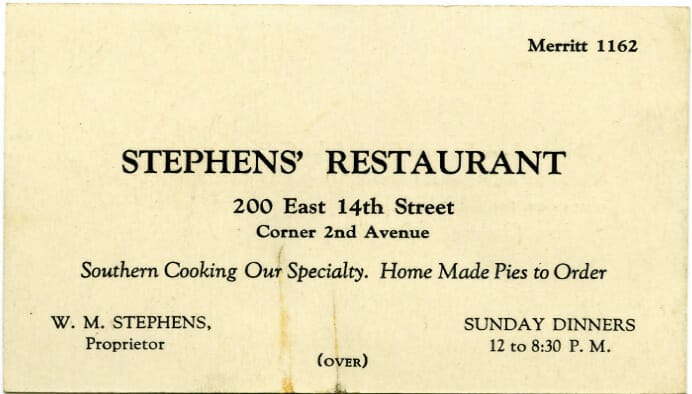
The William M. Stephens family was a successful African American family from Oakland. They owned the Stephens Restaurant, and their daughter Virginia won acclaim at the age of fourteen when her name, Jewel City, was selected for the Panama-Pacific International Exposition buildings in a competition sponsored by the San Francisco Call-Post. Virginia was the first African American woman to receive a law degree from the University of California. Berkeley’s Boalt School of Law in 1929.

Stephens Restaurant at 200 East 14th Oakland
Circa 1925 – photo by M.L. Cohen

Stephens Family papers, MS 5, African American Museum & Library at Oakland, Oakland Public Library. Oakland, California.

The Stephens Family

William Stephens Circa 1901
Stephens Family papers, MS 5, African American Museum & Library at Oakland, Oakland Public Library. Oakland, California

William Stephens was born in 1870 in Accomack County, Virginia. He moved to California as a child and attended school in Oakland and San Francisco. After graduation, Stephens completed Heald College coursework before working with the Southern Pacific Railway in 1886. Beginning as a Sleeping Car Porter, he worked his way up to a clerkship under H.E. Huntington, the company’s President’s assistant.

In 1894, he lived at 1132 Linden Street in West Oakland.

In 1898, Stephens resigned from Southern Pacific and took a position with the Crocker family. During these travels, Stephens learned about the hotel and restaurant business.

In 1901, he married Pauline Logan (1874-1929) of Tehama, California.

Pauline Stephens circa 1898
Stephens Family papers, MS 5, African American Museum & Library at Oakland, Oakland Public Library. Oakland, California.

Pauline gave birth to one daughter, Annie Virginia (who went by Virginia), on April 7, 1903. Due to his daughter’s health problems as a young girl, Stephens resigned from his post with the Crockers and began working at an Oakland social club. He moved on from this position in 1915 to manage the clubhouse at the Hotel Del Monte Golf and Country Club in Monterey County.

Pauline died in May 1929.

Oakland Tribune May 29, 1929

William died on November 21, 1932

Oakland Tribune Dec 2, 1932

Stephens’ Restaurant

Stephens worked at the Del Monte Hotel for about nine years, where he learned more about the restaurant business. His first venture was the Joy Lunch Room. He was successful in his first business, and in 1927, the old Joy Lunch became known as Stephens Restaurant.

Group of men standing in front of Stephens’ Restaurant & Lunch Room at 110 East 14th circa the 1920s
Stephens Family papers, MS 5, African American Museum & Library at Oakland, Oakland Public Library. Oakland, California

The restaurant soon became the dining rendezvous of the city’s ultra-fashionable folk and provided lucrative employment to young African American men and women.

California Eagle Dec 1930

Stephens’ restaurant grew from small quarters into an ample establishment seating over 200 people, occupying three locations near Lake Merritt.

William Stephens (right) and employee inside Stephens’ Restaurant circa the 1920s
Stephens Family papers, MS 5, African American Museum & Library at Oakland, Oakland Public Library. Oakland, California.

The restaurant enjoyed great success during the 1920s and 1930s and was usually filled. Stephens took great delight in employing African American high school and college students so they could earn money for their education.

Oakland Tribune 1927

In 1936, it was announced that the restaurant had added a cocktail lounge and was under the management of George Devant and Charles Simpson (Stephens’s nephew). Charles inherited the recipes that made the restaurant famous.

The final location of the restaurant was 200 East 14th (now International Blvd) at 2nd Ave. It was in business until 1938, when Narcissi’s Italian Restaurant opened.

Stephens Cocktail Lounge

Known to gourmets for years as the

“home of real Southern cooking”

Oakland Tribune Mar 27, 1936
Oakland Tribune 1936

Virginia Stephens


Annie Virginia Stephens, the only child of William and Paul, was born in Oakland on April 7, 1903. She attended public schools in Oakland until the family moved to Pacific Grove, where she graduated from high school.

In 1915, the San Francisco Call-Post held a naming contest for the buildings within the Panama-Pacific International Exposition. Virginia won the competition (1,300 titles were submitted) when her name, “Jewel City,” was selected; she was twelve at the time.

“We regret to say that when it was discovered that Miss Stephens had colored blood there was a sudden silence on the part of the press and the recognition ever given her was a season ticket to the grounds.”

The Crisis, Vol. 11 pg 36, No. 1

College

Virginia attended the University of California at Berkeley and received a bachelor’s degree in science in 1924.

While at Berkeley, Virginia, Ida L. Jackson was a charter member of the Rho Chapter in 1921 and Alpha Nu Omega, a graduate chapter of Alpha Kappa Alpha. These were among the first Greek sororities for African American women west of the Mississippi.

Members of Rho Chapter of Alpha Kappa Alpha Sorority, University of California, Berkeley (left-right): Virginia Stephens, Oreatheal Richardson, Myrtle Price (in back), Ida Jackson (sorority president), Talma Brooks, and Ruby Jefferson (1921), 
African American Museum and Library at Oakland. 

Encouraged by her father to attend law school, she enrolled in the Boalt School of Law at UC Berkeley and earned a degree in 19 9. At that time, she was only the second woman to receive a law degree from the school and the first African American woman to complete the program. Virginia passed the California Bar the same year, the first African American female Attorney in California.

California Eagle 1930

Virginia married attorney George Coker (1906-1970) The Cokers helped tutor African American students for the State bar exams They moved to Virginia and maintained a private law practice there for almost a decade.

In 1939 after working in private practice for ten years, they moved back to California, settling in Sacramento. Virginia was appointed Attorney in the State Office of the Legislature Council in Sacramento in May 1939 In this capacity, she helped with drafting and amending legislative bills and worked under four different legislative councils:

Upon her retirement in 1966, Virginia attained the position of Deputy of the Indexing Section. She died in Sacramento on February 11, 1986, at the age of 83.

More:

The End

Posted in History

Fire in the Hills – 1943

In December 1943, winds reached speeds of up to 75 mph, sparking numerous fires in the hills and the East Bay. There were at least 10 brush and grass fires reported all over Northern California.

Oakland Tribune Dec 9, 1943

The fire in the Oakland hills started near Broadway Terrace and Skyline, in the area above the Broadway Tunnel (Caldecott Tunnel). There was also a fire on Snake Road.

The smell of burning eucalyptus hung over the city for hours

Oakland Tribune Dec 09, 1943

The fire started just after midnight and burned for about 3 hours. The fire was most likely started by downed wires knocked down by gale-force winds.

Oakland Tribune Dec 9, 1943

The civilian defense police knocked on doors to tell the residents of Broadway Terrace, Upper Montclair, and Piedmont Pines to evacuate.


Oakland Tribune Dec 9, 1943

Half the city’s firefighting equipment was rushed to the Broadway Terrace area.

Oakland Tribune Dec 9, 1943

A total of 37 alarms were called between midnight and 8 a.m., and all off-duty firemen and police were ordered to stand by.

Oakland Tribune Dec 9, 1943

Few injuries were reported.

Wind and Fires Wreak Havoc

Oakland Tribune Dec 9, 1943

Oakland’s garbage disposal plant on Davis Street in San Leandro was destroyed.

Oakland Tribune Dec 9, 1943
  • Fire destroyed the garbage facility at the end of Davis Street
  • Fire on Mt. Diablo
  • 50 Boats smashed in Monterey
  • Tilden Park Fire
  • 1800 Acres burned in Concord
  • Napa County Swept by Fire

More

Posted in History

Leona Canyon Fire – Oct 1960

Oakland Tribune October 16, 1960

On Saturday, October 15, 1960, a brush fire started in the area of Mountain Blvd and Burckhalter Avenue.

The fire bore a striking resemblance to the disastrous 1923 Berkeley fire, which swept from the hills, destroyed 600 buildings, and leaving 4000 homeless.

Oakland Tribune October 16, 1960

The fire started at 11am and was under control by 2:30 pm and officially out by 4pm.

Oakland Tribune October 16, 1960

More than 200 firemen from the Oakland and San Leandro fought the fire for over four hours with the help of the residents who lived in the area. At times the fire came within feet of homes and rained sparks on their roofs. The damage was held to the loss of two houses, brush and oak trees.

From noon until 2pm the battle was a see-saw affair

Oakland Tribune October 16, 1960

Weekend Warriors

SF Examiner October 16, 1960

For the residents, it was a battle to the death. They stood of roofs and garages pointing hoses with little pressure behind them at the walls of flame, which roared through the brush and oak trees.

In the hills above, Leona Street flames roared 50 feet into the air and came within that distance of homes. At one point, police advised people to advise the residents on Leona Street, Mountain Blvd, and Mountain View Avenue to evacuate.

Cause Unknown

Oakland Tribune October 16, 1960

The cause of the fire was unknown. It ranged over an estimated 1200 acres after it starts near Mountain Blvd and Burckhalter Avenue. It’s course along Mountain Blvd northwesterly to Bermuda Avenue and up the hill towards Skyline Blvd.

There were unconfirmed reports of two boys playing with matches in the quarry area just before the fire started.

Oakland Tribune October 16, 1960

At the time, the winds gusted 45 mile-per-hour, which spread the fire across Mountain Blvd. but quick work by firemen and homeowners stopped the fire from spreading in that direction.

More than 100 homes were endangered during the day. Most were in the $30,000 bracket.

The Homes

  • 6384 Mountain Blvd – destroyed
  • 6434 Mountain Blvd – destroyed

The home at 6434 Mountain Blvd belonged to William Crecque, and 6384 Mountain Blvd belonged to Charles Suggs.

More

The End

Posted in Black History, People, Then and Now

Royal E. Towns – Engine Company No. 22

 Royal Edward Towns (February 10, 1899–July 23, 1990) was one of the first Black firefighters in Oakland. He was born in Oakland.

Royal E. Towns

He joined the OFD in 1927 and was assigned to Engine Company No. 22, a segregated firehouse in West Oakland. The station is located at 3320 Magnolia Street. He helped train many other black applicants to pass the test and was a scoutmaster for a Boy Scout troop that included Sam Golden, who became the first African American fire chief in Oakland.

The exterior of Engine No 22 firehouse

Royal Towns was the 11th black Oakland fireman hired in 1927. They didn’t employ the 12th for another 15 years.

Royal E. Towns and his colleagues with Engine Company No. 22 of the racially segregated Oakland Fire Department. (1943)

In 1971, there were only 35 black firefighters.

Towns became the first to be promoted in the OFD. He became a chief operator in 1941 and retired as a lieutenant in 1962.

Royal Towns on the left with Oakland firefighters standing in front of fire engine no. 22 – Circa 1943

Royal Towns was instrumental in helping desegregate the fire department. He helped train many other black applicants to pass the fire department test.

Personal Life

Royal Towns was born in Oakland on February 10, 1899, to William and Elizabeth Towns.

Towns married Lucille Dennis on May 26, 1920. They had three children and lived in various locations within Oakland.

Royal E. Towns died July 23, 1990, and is buried in Mountain View Cemetery.

More Photos

The photos are courtesy of the Royal E. Towns papers, MS 26, African American Museum and Library at Oakland, Oakland Public Library. Oakland, California. Photos at Calisphere

3320 Magnolia Street Oakland – Then and Now
It is no longer a Fire Station
Rolling Hoses in front of Engine No. 22
Two firefighters attaching hoses to a fire hydrant, firefighters practicing with fire hoses in the park in the background – on Peralta Street
Today Google Maps
Firefighters holding a fire hose in the street next to
Gleason and Company building
and today
Firefighters are holding a fire hose in the street next to Gleason and Company building.
Circa 1950s – 34th and Magnolia
Firefighters are holding a fire hose in the street next to Gleason and Company building.
Circa 1950s – 34th and Magnolia
and today
Looking down Magnolia towards 34th St

More on Royal E. Towns

The End