Slim Jenkins saw economic opportunity in the business district and opened a liquor store on December 5, 1933, the same day Prohibition was repealed. Soon, the business expanded to a cafe.
As I take a little break from my series on the schools in Oakland, I thought I would share this little bit of history with you.
Historic American Buildings Survey, Creator. Thomas Mahoney House, 69 Eighth Street, Oakland, Alameda County, CA . Documentation Compiled After. Photograph. Retrieved from the Library of Congress, <www.loc.gov/item/ca0013/>.
I’ve seen these photos many times before while doing research. They appeared again yesterday, so I decided to investigate and see what I could find.
Historic American Buildings Survey, Creator. Thomas Mahoney House, 69 Eighth Street, Oakland, Alameda County, CA . Documentation Compiled After. Photograph. Retrieved from the Library of Congress, <www.loc.gov/item/ca0013/>.
Both photos are online at the Library of Congress. Please note that the LOC description contains a typo. The address is 669 Eighth Street.
I don’t know what happened to the house after these photos were taken. I will let you know if I find out.
Update:I found a 1979 article in the Oakland Tribune stating that the house was moved to a new location because it was in the way of the proposed freeway.
Early Pioneer
So, I started looking into Thomas Mahoney (sometimes spelled Mahony). I was amazed to find a Thomas Mahoney living at 669 Eight Street in 1871. In the 1880 census, he lived there with his wife and four children. I then located in an obituary from January 1900. In the obituary, I notice his daughter Laura’s married name is Bassett
!8718 Directory
1888 Directory
Mahoney came to California in the 1850s. He mined for a while in Tuolumne County before retiring on his ranch in the Hills of Oakland. In 1863, he sold his ranch and moved to the home on Eighth Street next to St. John’s Episcopal. He was married in 1863 and raised four children in the house. His wife died in 1891, and he died in 1900.
His obituary
Oakland Tribune Jan 29, 1900
Thomas Mahoney, a well-known pioneer of this city, died at his home at 660 Eighth Street, last evening, in the 71st year of his age.
The deceased was a native of Ireland who came to this State many years ago to ranch. He owned a large tract of land to the north of the present city limits, from which the managers of the burial places purposely carved the sites now comprising Mountain View, St. Mary’s, and the Jewish Cemeteries.
The deceased was a widower, his wife having died several years ago. He was the father of Mrs. Laura J. Bassett, Louise H., Emma E., and George Mahoney.
The funeral services will be held next Wednesday in St. John’s Episcopal Church. The interment will take place in St. Mary’s Cemetery.
Family members continued to live in the home until around 1913.
St. Mary’s Cemetery
1863, Archbishop Alemany purchased 36 acres of land from Thomas Mahoney, known as the “Mahoney Ranch.” The land is now St. Mary’s Cemetery, next to Mountain View Cemetery. Thomas Mahoney was buried there in 1900.
Laura Mahoney Bassett was well known for her reminiscences in the Sunday Knave of the Oakland Tribune. She was Thomas Mahoney’s oldest daughter, born in Oakland in 1866, and lived there for most of her 80 years. She died in 1950.
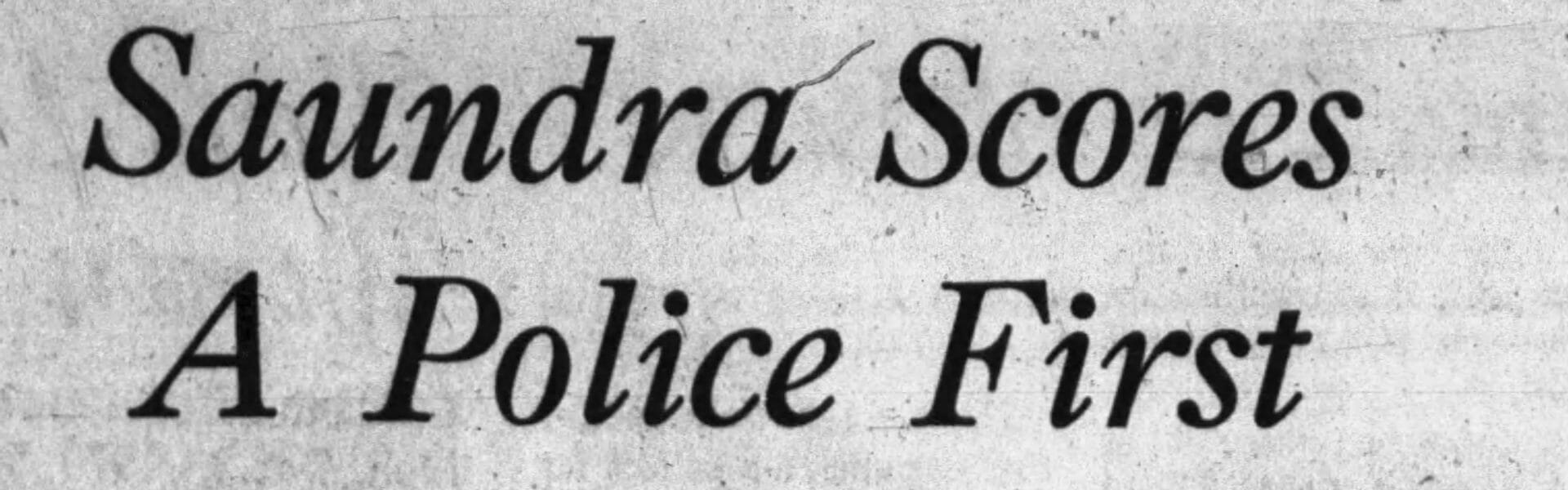
In 1970, Saundra Brown was the first black woman accepted into the Oakland Police Department’s Recruits Academy.
SF Examiner December 18, 1970
“I’m kind of optimistic”
Saundra Brown December 1970
Born and raised in Oakland. She felt she knew the problems of the young here. She said, “in a city like Oakland, with its Black Panthers and militant groups, there is a special need for minority police officers.” She worked with teens during her college days.
Saundra graduated from Fresno College with a sociology degree. She had always wanted to work with juveniles and considered law enforcement a possible field. She applied to OPD immediately after her June 1969 graduation, but no opening existed.
She was working as a claims adjuster when she heard that OPD was looking for a “black policewomen.”
Police Academy
Saundra Brown, the first black woman on the Oakland police force
At that time, a MALE recruit needed only a high school diploma or a score 262 on a GED course. WOMEN must have a four-year college degree or four years of experience in law enforcement. She had that.
She attended the same 15 weeks of Police Academy as the 22 males in her class and was expected to compete with them.
She took courses in criminal law and report writing, first aid traffic investigation, and the Oakland penal code. There were also defensive tactics involving strenuous activities such as calisthenics, some judo, and a little karate.
SF Examiner December 1970
“Oh, I did alright I guess” she laughed. I can throw the biggest guy in the class.“
Saundra Brown – December 17, 1970
During the course, she learned, for the first time in her life, to handle firearms.
“I used to be scared of guns,” she laughed,. “but now I feel safer with a gun in possession because I know how to use it”
Oakland Tribune Dec 14, 1970
Graduation
Oakland TribunDecember 1414, 1970
On December 18, 1970, she accepted her star and adulations from Police Chief Charles Gain as the only woman in the police academy of 24.
She finished at the top of her class. She hoped to be assigned to the juvenile division.
However, there were differences between policemen and women. Saundra didn’t wear a uniform when assigned to community relations and the youth department.
At that time, there were 710 men in the force and only seven women. They made the same money as at the start, but there was quite a contrast in recruitment qualifications and future advancement. Women were not allowed to compete with men for advancement then; they would always hold the rank of policewomen.
Fascinated by the legal issues she encountered as a policewoman, Saundra attended law school while continuing to serve her hometown of Oakland as a police officer until 1977.
She was a judicial extern at the California Court of Appeals in 1977 and a deputy district attorney in Alameda County, California, from 1978 to 1979, 1980 to 1982. From 1979 to 1980, she was a senior consultant to the California Assembly Committee on Criminal Justice.
She was a trial attorney of the United States Department of Justice Public Integrity Section from 1982 to 1983. She then served as a Commissioner on the Consumer Product Safety Commission from 1983 to 1986 and the United States Parole Commission from 1986 to 1989.
SF ExamineJanuary 22, 1989
She was a judge at the Alameda Superior Court, California, from 1989 to 1991.
Judge Saundra Brown Armstrong official portrait art by Scott Johnston, oil on linen, 38×27-inches, collection of the United States District Court of Northern California, Oakland
On April 25, 1991, President George H. W. Bush nominated Armstrong to a seat on the United States District Court for the Northern District of California vacated by William Austin Ingram. She was confirmed by the United States Senate on June 14, 1991, and received her commission on June 18, 1991.
She earned a Master of Divinity (M.Div.) from the Pacific School of Religion in 2012, and she assumed senior status on March 23, 2012
I hope to show Then and Now images of Oakland Schools in this series of posts. Along with a bit of the history of each school, I highlight. Some photos are in the form of drawings or postcards or from the pages of history books.
Note: Piecing together the history of some of the older schools is sometimes tricky. I do this all at home and online — a work in progress for some. I have been updating my posts when I find something new. Let me know of any mistakes or additions.
Updated December 17, 2019
Montclair Grammar School
Oakland Tribune September 20, 1925
The Montclair District held formal dedication ceremonies in their first school on March 14, 1926. The service is under the direction of A.R. Romer, the principal, and Mrs. J.D. Bishop, the teacher in charge of the 71 students already registered to attend the school.
Oakland Tribune March 15, 1926
The four-room schoolhouse was built with funds from the building program funded by a $9,000,000 bond issue voted by the people of Oakland in 1924.
In attendance were Mrs. Stanton Lore representing the Montclair Women’s Club, and Mrs. E.T. Jepsen of the Piedmont Avenue PTA
Oakland Tribune 1926
Montclair School 1927
Montclair School 1927
Montclair School 1927
The original brick building with a tile roof was later considered an earthquake risk and razed in 1936. They used portables for many years.
Oakland Tribune Oct 1936
The new school building was dedicated in 1942, with nine classrooms, an administrative suite, an arts and crafts room, a PTA room, and a Library, was created. In 1947, a Cafeteria and Assembly Hall were added.
Auditorium
Montclair in the 1950s
Montclair is located at 1757 Mountain Blvd., Oakland.
Montclair Today
In 2013, a new building was added to the campus, which houses a modern Multipurpose Room, new classrooms, a faculty lounge, and a living roof. A new learning garden and play structure were also added to the campus.
Plans for a new school in the Montclair District were drawn up by local Montclair residents Robert “Bob” Goetz and Jens Hansen in association with Confer and Willis.
Drawing of Thornhill 1956
The site on Thornhill Drive at Alhambra was acquired through condemnation proceedings. The court awarded $48,000 to the landowner, Alice Taylor.
Oakland Tribune July 4, 1956
Oakland Tribune July 4, 1956Oakland Tribune August 28, 1957Montclarion 1957
The school was to be ready in September 1958 and would have an administration office, a multipurpose room, a library, 11 classrooms, and a kindergarten room.
Montclarion Oct 23, 1957Oakland Tribune June 22, 1958
Thornhill 1959-60
Dedication – November 12, 1958
The Montclarion Nov. 12, 1958
November 12, 1958
November 12, 1958
The Montclarion Nov 1958
Bus Service
The district approved the school bus earlier in the year, stopping at both Thornhill and Montclair schools. The kids were picked up throughout the hills on the roads designated ‘safe.’ The bus service continued until 1959, when the service was going to be pulled but continued a little longer after the parents rallied to raise money to maintain the service.
Menu 1959Jan 1959Jan 1959The Montclarion
Thornhill 1963-64
The school is located at 5880 Thornhill Dr, Oakland
The bid was taken in November 1949 for the New Joaquin Miller Elementary School on Ascot Drive in Montclair.
Oakland Tribune November 1950
Oakland Tribune November 1950 Tribune
First Graduate
In January of 1950, Judith Lowe, 12 daughters of Mr. and Mrs. Robert Lowe, had the honor of being the first graduate of the school – she was the only one. She was the lone pupil in high sixth grade.
The Grateful Dead once partied at 6024 Ascot Drive in the Piedmont Pines section of Oakland.
6024 Ascot Drive
Oakland Tribune May9, 1948
In 1948 house at 6024 Ascot Drive was advertised as an ‘ A Little Bit of Mexico” in beautiful Piedmont Hills ( Piedmont Pines), nestled in a glorious 2 1/4 acres: balconies overlooking a beautiful swimming pool. All the tiles in the bathrooms came from the Muresque Tile Co. of Oakland, one of the premier West Coast tilemakers in the 1920s and ’30s. Property highlights include a log cabin family room.
In 1968 Michael Leibert, his wife Alexa, and their 5 dogs lived at 6024 Ascot. Leibert was the founder of the Berkeley Repertory Theater.
The house had a routine existence until sometime during the late sixties, the house was rented by Owsley “Bear” Stanley (1935-2011) was an American audio engineer and chemist.
Stanley was the first known private individual to manufacture mass quantities of LSD. By his own account, between 1965 and 1967, Stanley produced no less than 500 grams of LSD, amounting to a little more than five million doses.
Bear: The Life and Times of Augustus Owsley Stanley III
By Robert Greenfield Google Books Bear: The Life and Times of Augustus Owsley Stanley III
By Robert GreenfieldOakland Tribune Jul 16, 1970
In 1972 the house was advertised an authentic Spanish “Villa.” Back on the market.
Oakland Tribune May 21, 1972
SF Examiner 1998
The house was sold in 2012 for 1.2 million dollars. A September 2012 article, “Rest Your Head Where the Grateful Dead Once Partied,” was posted on the Curbed San Francisco website.
I hope to show Then and Now images of Oakland Schools in this series of posts. I highlight a bit of the history of each school. Some photos are in the form of drawings or postcards or from the pages of history books.
Note: Piecing together the history of some of the older schools can be tricky. I do this all at home and online—a work in progress for some. I have been updating my posts when I find something new. Let me know if I make any mistakes or add anything.
Fruitvale Schools 1-3
UPDATED AUGUST 2024
“Fruit vale Public School” – LatterFruitvale No. 1
Fruitvale School, in the early 1880s, was situated on the field. Circa 1880s OMCA H97.1.48
Oakland Tribune Jan 07, 1880
From what I can tell, the school was in the exact general location of Fruitvale Elementary School today, at the corner of Boston Street and School Street.
New Life as Church
1896, after Fruitvale No. 1 was built, the old school was moved and remodeled for use as a church. It was re-dedicated as the Higgins Methodist Episcopal Church in March of 1896.
SF Call Mar 09, 1886
SF Examiner March 1896
The Fruit Vale (as it was sometimes spelled) School district was formed in 1889 to build a new schoolhouse.
SF Examiner June 4, 1889
Fruitvale No. 1 – FruitvaleElementary School
In 1894, in the Fruitvale School district, the trustees were forced to meet the demand and take steps to build a larger school. The new school replaced the old Fruitvale School building from the 1880s.
SF Call Aug 27, 1895
The plans called for a $13,000 2-story building with a concrete basement. Each floor was to have four large classrooms and lunchrooms for the teachers. The principal’s office was on the first floor, and a space was reserved for a library. The basement had separate playrooms for the boys and girls, janitor rooms, and a heating apparatus.
“The building cost was $16,000, and it is located in the healthiest spots of this healthy locality.”
SF Call August 27, 1895
The style of the new building was the Italian Renaissance. The architects were Cunningham Bros. of Oakland.
SF Call Aug 27, 1895
Oakland Tribune Jul 26, 1889
The pastures of the Empire Dairy surrounded the school from 1880-1901
Oakland Tribune Dec 13, 1970
Fruitvale School circa 1901
In 1913, Fruitvale School No. 1 was changed to just Fruitvale School.
New School Built
The new Fruitvale School was dedicated on December 1, 1950. It has 14 classrooms, a library, a cafeteria, a kindergarten, and an auditorium. The school was designed by Ponsford and Price Architects and cost $497,700. It can accommodate 569 students.
Oakland Tribune Nov 09, 1949
The dedication was attended by William Taylor, a long-time resident of the Fruitvale District; he was a student at the “old Fruitvale School “in the 1880s. Oakland Tribune June 1962
In 1913, the name of Fruitvale School No. 2 was changed to Hawthorne School. The school was on Fruitvale at East 17th (Tallant Street)
Hawthorne School Circa 1900 – Cheney Photo Advertising
1923, a concrete culvert was built, and Sausal Creek was filled in.
School Destroyed by Fire in 1923
Oakland Tribune Apr 30, 1923
On the morning of April 30, 1923, 750 pupils, teachers, and staff of the Hawthorne School were evacuated from their classrooms while the entire upper portion of the building was being destroyed by fire. The fire was believed to have started from sparks that fell from the chimney.
Oakland Tribune Apr 30, 1923
Three alarms were sounded, and all available firefighting apparatus rushed to the scene. Two firemen were hurt when a portion of the burning roof gave way.
New School Built
The district purchased the property fronting on East 17th Street, adjoining the playground. The new school was built away from the noise and traffic of Fruitvale Ave.
Oakland Tribune Sept 21, 1924
In September 1924, they laid the cornerstone of the new school building, which John J. Donovandesigned. The two-story building, which cost $102,000, contained ten classrooms, offices, and a room for the PTA.
The new school is located at 28th Avenue at East 17th Street, across from the old Fruitvale School No 2. The old school building was destroyed by fire the year before.
Oakland Tribune Sept 21, 1924
The following items were put into the sealed cornerstone:
Minutes of Board of Education May 1924
Minutes of Board of Education June 1924
Outline of the school plans
Program from Cornerstone ceremony
History of the PTA
Names of all the pupils enrolled
Group photos of all the classes.
School Directory
The new school opened in January 1925.
Oakland Tribune Jan 24, 1925
The school is located at 1700 28th Ave, Oakland, CA 94601
Achieve Academy (TK-5) serves students in the Fruitvale neighborhood and is one of Oakland’s highest-performing elementary campuses.
Hawthorne School -photo by Richard A. Walker Creative Commons 2023
Fruitvale No. 3 – Allendale School
Before 1904, children living along High Street had to walk to Fruitvale School No. 1 on School Street. The Allendale District was chosen because of its central location for the children from Laurel Grove District (Laurel District) to High Street and Foothill Blvd, then known as Old County Road.
Fruitvale School No. 3 was built in the Allendale neighborhood in 1904.
The 1904 school building cost $107,437 to build. The first year’s enrollment was 809. A four-room addition was added in 1910, and another four rooms, costing $49,458, were added in 1928.
Oakland Tribune July 19, 1910
Miss Alice V. Baxley was the first principal of Allendale School from 1904 to 1913.
Fruitvale No 3 – Renamed Allendale 1913
In 1913 Fruitvale No. 3 was renamed Allendale School.
Oakland Tribune Mar 1913
Oakland Tribuine Mar 1914
Dangerous and a Hazard
The school was deemed unsafe and closed in 1953. At the time, it was one of the oldest school buildings; two others from the pre-1906 era were still standing. The old school building withstood the 1906 earthquake.
San Francisco Examiner Dec 1953
SF Examiner Dec 20, 1953
Seventeen portables were placed on the site to house the students until the fall of 1959.
The Old Allendale School Just Before Demolition – From the Family of Doss Welsh
OaklandnTribune June 21, 1957
The day of reckoning has come for the old Allendale School building which has been razed”
The new school, Allendale-Fruitvale Junior High, was constructed at Hopkins (MacArthur Blvd) and Coolidge Avenue.
Oakland Tribune Oct 10, 1928
Oakland Tribune Nov 9, 1928
The Allendale-Fruitvale Junior High was changed to Bret Harte Junior High at a school board meeting in 1929; the other name under consideration was Dimond Junior High.
The school was named after Bret Harte, an American author and poet best known for his somewhat romanticized accounts of pioneer life in California. He lived in Oakland from about 1854 to 1857 at the home of his stepfather, Colonel Andrew F. Williams, who was later Oakland’s fourth mayor.
Oakland Tribune Nov 16, 1930
The school was the last to the new school to be built out of the 1924 Bond issue. It was constructed at the cost of $120,000.
The building contained 22 classrooms, and on opening day in 1930, 699 pupils enrolled. The school graduated students from Fruitvale, Allendale, Sequoia, and Laurel Schools.
The school opened in 1930.
The Oakland Post Enquirer Jan10, 1930
The school’s auditorium gymnasium building was constructed in 1950.
The Oakland Post Enquirer Aug 2, 1950
Oakland Tribune Aug 29, 1950
In 1957, the school district opened bids for a new building at Bret Harte.
Oakland Tribune July 7, 1957
The new building was built on campus in 1959, and another major expansion occurred in 1979.
The 1930 time capsule in a copper box found during the 1979 construction was never opened and has since been lost.
The school is located at 3700 Coolidge Avenue, Oakland, CA 94602
In this series of posts, I hope to show Then and Now images Oakland Schools. Along with a bit of history of each school, I highlight. Some of the photos are in the form of drawings or postcards, or from the pages of history books.
Note: Piecing together the history of some of the older schools is sometimes tricky. I do this all at home and online — a work in progress for some. I have been updating my posts when I find something new. Let me know of any mistakes or additions.
Updated Jan 12, 2020
Manzanita Grammar School
In 1909 the Board of Education annexed the Fruitvale and Melrose School Districts. More on the history of annexationin Oakland.
Oakland Tribune 1909
Oakland Tribune 1910
The first school to open was Manzanita Grammar School, located on 26th Street between 24th and 25th.
The 2-story building with 8 classrooms, a principal’s office, teachers’ locker room, library, and a kitchen was designed by F.D. Voorhees and cost $23,000.
Oakland Tribune June 28, 1970
In 1920 there was a gas explosion in the basement of the school.
Manzanita Annex
Oakland Tribune Jan 1926 Best Copy I could Get
In January of 1926, the board of education accepted the plans for an annex to be added to the building already on the site. The new structure will cost $70,000.
In September of 1926, it was determined that the (new) Manzanita Annex that was more than halfway done was unsafe. The concrete work was entirely defective, and to make the building safe for occupancy, they had to remove the entire structure above the foundation.
Oakland Tribune Sept 1926
The Alameda County Grand Jury was asked to investigate the faulty construction of the $70,000 school building.
New School Dedicated
A dedication ceremony was held in January of 1927 for the new $70,000 Manzanita School Annex at 24th Avenue and E.26th. The Mission style edifice had 8 classrooms and kindergarten and a restroom for teachers.
The new building adjoined the old school building.
Oakland Tribune Jul 4, 1956
In 1956 it was proposed that the 46-year-old 3-story building would be replaced with a new school building.
In 1958 bids were accepted to demolish the old school built-in 1909.
Oakland Tribune Aug 1958
The new building was designed by Donald S. Mackey architect, and it contained 15 classrooms, 1 kindergarten, 1 special education room, a cafeteria, a library, and offices.
The new building was dedicated in September 1958
Manzanita Today
Manzanita is located at 2409 East 27th Street, Oakland.
Manzanita School Today
Manzanita Community School (MCS) is a small school located in the heart of the Fruitvale neighborhood. Our bilingual program is K-3. We are one of the most diverse schools in OUSD.
I am sorry to say I haven’t been too lucky with finding pictures of the first school or older pictures of the present school. Hopefully, someone might have some to share.
The School Today
Maxwell Park School was established in August of 1924, in a single portable shack. It was then a part of Horace Mann School. There were 108 students registered that first year.
In April 1925, preliminarily plans for a new Maxwell Park school were approved.
In 1925 it became a separate school, with Miss. Sue Dunbar as the principal and a faculty of four teachers.
In January of 1926, a new six-room structure was dedicated.
I haven’t found any picture of the first school.
Oakland Tribune Jan 1926
Oakland Tribune 1928
Additions are added
Oakland Tribune Aug 10, 1930
Oakland Tribune July 1930
The new addition was complete, and they eliminated the need for the portables, for now.
Oakland Tribune Jan 04, 1931
More construction in 1936
Oakland Tribune Mar 1936
The school is located at 4730 Fleming Avenue, Oakland
Maxwell Park Now
Today
Melrose Leadership Academy now uses the school. It is a dual immersion school in the form of bilingual education; Website
Elizabeth Sherman Elementary School
Sherman Elementary School is located in Maxwell Park The site close to Mills College.
In 1931 a new auditorium was dedicated. The auditorium was called “Little Theater,” and it consisted of two portables joined together to make one. There was a stage built at one end.
Named After
Sherman Elementary was named after Elizabeth Sherman (September 5, 1859 – June 27, 1937) was a long-time educator in Oakland in 1931.
In 1887 she was teaching at Lafayette Elementary School By 1907, she was the principal of the school. She retired from teaching in 1928.
New School
Oakland Tribune July 03, 1956
In 1956 architects Foulkes and Dennis drew up the plans for a structure to serve 325 students.
The new unit included an administration office, library, eight classrooms, one kindergarten, one special ed classroom, and a music room. They continued to use the auditorium built-in 1936.
The ground was broken for the new school in May of 1957, and the students moved in February 1958. A formal dedication was in April 1958.
Oakland Tribune Feb 09, 1958
Sherman Today
The school is located at 5328 Brann St.
Sherman Today
Today Melrose Leadership Academy and Urban Montessori share the campuses at Maxwell Park and Sherman.
Urban Montessori Charter School (UMCS) opened in the fall of 2012 and became Oakland’s first public Montessori school.
Melrose Leadership Academy (MLA) is a public school that emphasizes leadership development and focuses on social justice in partnership with our families
The Daniel Webster School is located at the large lot bounded by Plymouth, Olive, and 81st and 82ns Streets in East Oakland. The school over the years shorten the name to just Webster School.
Oakland Tribune November 27, 1921Oakland Tribune November 27, 1921
The school opened in 1922 with just 4 classrooms, 200 students, and plenty of room to grow.
The construction of a 14 room addition and an auditorium to the school was to begin in July of 1925.
Below is how the school looked in 1925.
Oakland Tribune Oac 27, 1925
Webster Today
The school is located at 8000 Birch St.
The Webster Elementary School site hosts the East Oakland Pride Elementary. A TK-5 school in the Arroyo Viejo neighborhood, situated on the old Webster Academy campus. We offer both Spanish-English bilingual and English-only programs in K-2; upper grades are taught in English.
I hope to show Then and Now images of Oakland Schools in this series of posts. I highlight a bit of the history of each school. Some photos are in the form of drawings or postcards or from the pages of history books.
Note: Piecing together the history of some of the older schools can be tricky. I do this all at home and online—a work in progress for some. I have been updating my posts when I find something new. Let me know if you have any additions.
Elmhurst Middle School
A June 1893 real estate ad for the Warner Tract in Elmhurst announced that.
building will commence soon on a new $15,000 schoolhouse upon the Warner Tract.
Oakland Evening Tribune Jun 26 1893
Elmhurst Grammar School was formally dedicated in July of 1894. The school contained four large classrooms.
New Addition for Elmhurst
The people of Elmhurst are requesting more room at Elmhurst; below is the proposed addition in 1903
Oakland Tribune July 29, 1903
In August of 1904, work had begun on the additions to Elmhurst School.
Oakland Tribune August 18, 1904
Oakland Tribune January 25, 1911
Elmhurst School circa 1912
Elmhurst School is now Elmhurst Junior High
With the opening of the Elmhurst Annex School ( E. Morris Cox), a junior high school was needed. A new school was built at the site of the Old Elmhurst School at 98th and Cherry and Birch Street. The new school opened in July 1927.
Oakland TribuneJuly, 31, 1927
John J. Donovan designed the new school. The structure is in classical design, with 21 classrooms and shops connected to manual training classes. Other features are an auditorium with a balcony and a motion picture projection room.
Modern Shops were added to Elmhurst.
Oakland Tribune June 23, 1926
Fires
In June of 1955, $35,00 destroyed one woodshop while damaging another.
In May 1967, Elmhurst Junior High suffered $25,000 in a suspected arson fire. It was the 7th school fire that year.
Elmhurst Today
Elmhurst is located at 1800 98th Avenue
Elmhurst Community Prep (ECP) is a triumphant middle school located in East Oakland. ECP prepares 6th – 8th-grade students for high school, college, and career by using a host of online and digital tools
McChesney started an elementary school built in 1913 at the intersection of 13th Avenue and East 38th Street. The school was named in honor of educator Joseph B. McChesney (1832-1912),Oakland High School‘s first Principal, who died the year before this school was finished.
In 1901 property was purchased for $1500 by the Melrose School District, then part of the unincorporated Brooklyn Township.
Bids opened in June of 1901. The entire amount used for construction and purchasing the property was $15,000.
Melrose School was dedicated in November 1901.
From the 1923 Fremont High School Yearbook
In 1905, Union High School No.4 was established at Melrose, and classes were held on the 2nd floor while plans were being drawn up for the new Fremont High School.
New School
In 1959, plans were drawn up to replace the 58-year-old Melrose School. The new building would hold 300 students plus faculty and have seven classrooms, one kindergarten, administration offices, a library, and a multipurpose room with a kitchen.
Oakland Tribune July 15, 1959
E.D. Cerruti designed the school.
Oakland Tribune May 10, 1959
The new Melrose Elementary was dedicated in December 1960. It was built on 53rd Avenue, and the old school was on 52nd Avenue.
Oakland Tribune December 7, 1960
Melrose Elementary School is located at 1325 53rd Avenue
It is now Bridges Academy at Melrose
We are building bridges from East Oakland to college and careers by breaking barriers to create a more just, equitable, and culturally responsive community
Melrose Heights school was later renamed Horace Mann (please see Part 1)
Oakland Tribune May 3, 1909
Melrose Heights was built in 1909. The building was designed by F.W. Burki, who chose the Renaissance style of architecture. The three-story building has 12 rooms, including eight classrooms and a basement. Cost $30,000
Melrose School, later Horace Mann School
Santa Fe School
Oakland Tribune Mov 30, 1913
Oakland Tribune Mar 29, 1914
Santa Fe School was formally dedicated in July 1914. John J. Donovan designed the school.
Oakland Tribune July 23, 1914
School Architecture: Principles and PracticesBy John Donovan 1921
New School Built
The new Santa Fe Elementary School was dedicated in February of 1960.
Santa Fe has been the temporary school for the students of Glenview Elementary while a new school is being rebuilt for them. The new school has 18 classrooms, two kindergartens, a multipurpose room, a library, and offices. It cost $809,879
I hope to show Then and Now images of Oakland Schools in this series of posts. Along with a bit of the history of each school, I highlight. Some photos are in the form of drawings or postcards or from the pages of history books.
Note: Piecing together the history of some of the older schools is sometimes tricky. I do this all at home and online — a work in progress for some. I have been updating my posts when I find something new. Let me know of any mistakes or additions.
Brookfield Village School
Brookfield Village school opened for the new school year in September of 1944, the latest of Oakland’s 77 schools.
“Brookfield Village Elementary School opened without the benefit of bells.”
Brookfield was Oakland’s newest public school, which opened under wartime handicaps. Money and supplies were tight. Classes were being held in 19 portables that arrived three weeks before school started.
767 boys and girls were enrolled, just 33 less than anticipated in that first year.
New School
In February 1950, they held a groundbreaking ceremony for Unit 1 of the new Brookfield Village School.
Oakland Tribune Mar 13, 1949
The school unit was designed byConfer and Willis. The new building had 11 classrooms, a library, and an auditorium. It was a one-story building of wood frame construction.
Oakland Tribune Apr 24,1951
New Addition
Oakland Tribune Oct 23, 1957
Oakland Tribune Nov 26, 1957
In November of 1957, they broke ground for new addition costing $286,680. The new building will include a cafeteria, ten classrooms, a kindergarten, plus two special classrooms.
Brookfield Today
Brookfield Lions: Learning and Thriving with Pride.
Google Maps
The school is located at 401 Jones Ave., Oakland, CA 94603
Clawson School dates back to the 1880s, as seen in the image below.
Clawson in 1895
Clawson Elementary School was built in 1915. This Neo-Classical design had two stories and utilized extensive terracotta ornamentation. The ornamentation around its front doors. The building was designed by
School Architecture: Principles and Practices
By John Joseph Donovan 1921
The Clawson Elementary School was listed as standing near the intersection of 32nd Street and Magnolia Street in Polk-Husted’s Oakland, California, City Directory, 1918
Kindergarten
Entrance to the Kindergarten Classroom Clawson School pergola, Oakland, California (1916) 1
Principal’s Office
Auditorium
School Architecture: Principles and Practices
By John Joseph Donovan 1921
Bathrooms Boys and Girls
Clawson Closed
The building functioned as a school until it was closed sometime between 1971-1973. OUSD closed three schools in 1973 rather than spend the money needed to retrofit them, including Clawson School. Clawson couldn’t meet the new stricter seismic standards that went into effect in 1973.
New Life
Clawson Lofts Today Google Maps
After extensive remodeling and structural upgrading, the building reopened as The West Clawson Lofts in 1999.
Emerson School 1912 John Galen Howard collection of progress photographs, ca. 1905-1910
The Bancroft Library, UC Berkeley
Emerson Elementary School was built in 1913. It was designed by John J Donovan and John Galen Howard. The total cost of the school was $163,879. It was located at 49th and Shafter Avenue.
Oakland Tribune Jan 28, 1912
Oakland tribune Sept 20, 1912
Oakland Tribune Mar 29, 1914
School Architecture: Principles and Practices
By John Joseph Donovan 1921
School Architecture: Principles and Practices
By John Joseph Donovan 1921
Emerson Now
The address is 4803 Lawton Avenue. In 1978, it was torn down because it was considered seismically unsafe.
I hope to show Then and Now images of Oakland Schools in this series of posts. Along with a bit of the history of each school, I highlight. Some photos are in the form of drawings or postcards or from the pages of history books.
Note: Piecing together the history of some of the older schools is sometimes tricky. I do this all at home and online — a work in progress for some. I have been updating my posts when I find something new. Let me know of any mistakes or additions.
Durant School
Bids were in to build a new school at the corner of West Street. A bid of $5000 made by J.J. Chaplain was the winner. The new school was called the Durant School in honor of the Rev. Henry J. Durant, the 16th Mayor of Oakland (1873-1875) and one of the founders of the University of California.
Durant School opened in August of 1875. It was reported by the Board of Education that all grades were formed and that they had over 400 pupils with eight teachers.
In 1878 a 6-room addition was added.
Durant Elementary School
Plans for a new Durant School to be built were accepted in 1912. The old school was sold. The new building was constructed at the corner of 29th and West Street and was to exceed $160,000.
School Architecture: Principles and Practices By John Joseph Donovan 1921
In 1971 (probably before), it was determined that the school was structurally unsafe in the event of an earthquake. Bids were requested for the construction of a new school. I don’t know what happened with that. I couldn’t locate any pictures of a newer Durant School.
Views of Oakland California’. Oakland: Pacific Press Publishing Company, 1893
Lafayette School was located at 17th and West Street and was built in the late 1860s.
The Lafayette Grammar School was one of the first schools built in Oakland. Lafayette even housed Oakland High School in 1869.
Oakland Tribune 1905
Lafayette Grammar School was named in honor of Marquis de Lafayette, a French military leader and statesman who fought on the side of the colonists during part of the American Revolution.
Lafayette Grammar School later changed its name to Lafayette Elementary School.
A brand new school was dedicated in October of 1949. Constructed at the cost of $594,825, the new school has 22 classrooms, a kindergarten, and an auditorium.
The school was established in 1909 as an annex of Grant School, which was overcrowded. The Board of Education built a temporary structure of two rooms at the corner of Van Buren and Perry Streets. They called the school the Grant Annex.
Oakland Tribune Sept 1913
With the rapid growth of the surrounding area, it soon became necessary to build a permanent school.
Oakland Tribune 1913
In 1913 a large red brick building was built in a modern style of architecture opposite the Grant Annex at the corner of Grand Avenue and Perry Street. The new school was called Lakeview.
Construction of Lakeview School – circa 1913-14
Lakeside School
John J. Donovan was the architect of Lakeview Elementary. The estimated cost of building the school was $75,000.
Lakeview was situated on a high terrace with ivy-covered banks. Two flights of broad steps lead from the main building to Grand Avenue.
Lakeview School is situated at the head of Lake Merritt and surround by the beautiful Piedmont Hills. In one of the most attractive districts of Oakland.
Oakland Tribune Oct 1917
Across the street from the main building were two attractive smaller buildings that could not be seen from Grand Avenue.
There were manual art portables and a playground complete with equipment.
It appears that Julia Morgan designed an addition to Lakeview in 1915
Oakland Tribune Feb 1915
By 1917 Lakeview had an enrollment of 768.
Lakeview School circa the 1930s
Fire at the Lakeview School Annex – May 1937
Oakland Tribune May 03, 1937
MacArthur Freeway –
In 1926 a group of Lakeview district residents appeared before the Board of Education to advocate steps to protect the area behind the school from future development. See below